![]() |
Basic Results overall long term more
|
Comparisons
seeds versus
external |
Outcome
|
|
|
Results with seed implants are worse for
patients with a higher Gleason Score (see
here.) For low risk patients (stage T1c or T2a, Gleason 6
and PSA < 10, if the patient gets a good seed implant (optimal
means the D90 dose = prescription dose) then the PSA cure rates
at 8 years may be 94% (see here.)
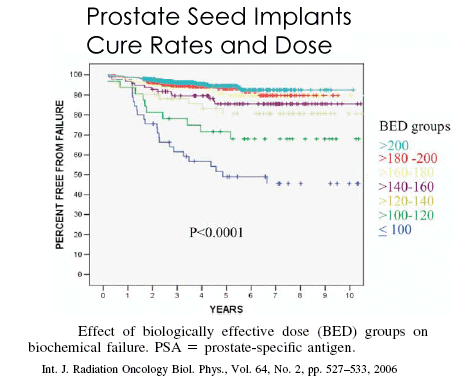
More studies show the importance of getting the proper dose to
the cancer (see
here,
here, and
here). The lower the PSA declines the better
chance of cure (go here), The longest published outcome results are 13 years and 15 years
|
|
|
Typical comparison studies include a local study of 1,305 T1/T2 patients treated with seeds (869) or radical prostatectomy (208) Curr Urol Rep 2002 Jun;3(3):250-7 |
||||||||||||
|
other studies are similar to that noted below The effect of prognostic factors on therapeutic outcome following
transperineal prostate brachytherapy.
The objectives of this study were to examine the effect of both disease and treatment related prognostic factors on biochemical control and post-treatment biopsy. Two-hundred fifty-eight patients underwent interactive ultrasound guided transperineal prostate implantation for T1-T2 prostate cancer using Iodine-125 (139 patients) and Palladium-103 (119 patients) and were followed from 6-67 months (median, 19). Hormonal therapy with 3 months of leuprolide and flutamide prior to implantation and two months given after the implant was used in 96 patients. Pre-treatment prostate-specific antigen (PSA) had the most significant effect on biochemical failure. Freedom from biochemical failure (FFBF) rates at 4 years were 75% for patients with PSA 1.3-10 ng/ml (144), 74% for patients with PSA 10.1-20 ng/ml (73), and 34% for patients with PSA > 20 ng/ml (41) (P = 0.0004). Gleason score also had a significant effect on FFBF rates. Four-year rates were 81%, 65% and 47% for patients with scores of 2-4 (68), 5-6 (130), and > or = 7 respectively (60) (P = 0.01). These two factors were also significant in multivariate analysis (P = 0.002, 0.007, respectively). Gleason score was the only factor to significantly affect post-treatment biopsy results. Patients with scores of 2-6 had 85% (63/ 74) negative 2-year biopsies versus 62% (13/21) for patients with scores > or = 7 (P = 0.02). Low-risk patients (PSA < or = 10 ng/ml, scores < 7 and stage < T2a) had a 4-year FFBF rate of 88% as compared to 60% for high-risk patients (PSA > 10 ng/ml, score > 6 or stage > or = T2b) (P = 0.02) and had a 95% negative biopsy rate versus 76% for high-risk patients (P = 0.06). Low-risk patients demonstrate high FFBF and negative biopsy rates following implantation. Patients presenting with higher risk prognostic factors such as PSA > 20 ng/ml or Gleason scores > or = 7 may require more aggressive treatment regimens. |