RTOG 9001 :
Pelvic Radiation with Concurrent Chemotherapy Compared with Pelvic and Para-Aortic
Radiation for High-Risk Cervical Cancer
Mitchell Morris, et al
Background and Methods. We compared the effect of radiotherapy to a pelvic and para-aortic
field with that of pelvic radiation and concurrent chemotherapy with fluorouracil and
cisplatin in women with advanced cervical cancer. Between 1990 and 1997, 403 women with
advanced cervical cancer confined to the pelvis (stages IIB through
IVA or stage IB or IIa with a tumor diameter of at least 5 cm or involvement of
pelvic lymph nodes) were randomly assigned to receive either 45 Gy
of radiation to the pelvis and para-aortic lymph nodes or 45 Gy of radiation to the
pelvis alone plus two cycles of fluorouracil and cisplatin (days
1 through 5 and days 22 through 26 of radiation). Patients were then to receive one or two applications of row-dose-rate intracavitary radiation, with a
third cycle of chemotherapy planned for rhe second intracavitary procedure in the
combined-therapy group.
Results. Of the 403 eligible patients, 193 in each group could be evaluated. The median
duration of follow-up was 43 months. Estimated cumulative rates of survival at five years were 73 percent among patients treated with
radiotherapy and chemotherapy and 58 percent among patients treated with radiotherapy
alone (P=0.004). Cumulative rates of disease-free survival at five years were
67 percent among patients in the combined-therapy group and 40 percent among patients in
the radiotherapy group (P<0.001). The rates of both distant metastases (P<0.001) and
locoregional recurrences (P<0.001) were significantly higher among patients treated
with radiotherapy alone. The seriousness of side effects was similar in the two groups,
with a higher rate of reversible hematologic effects in the combined-therapy group.
Conclusions. The addition of chemotherapy with fluorouracil and cisplatin to treatment
with external-beam and intracavitary radiation significantly improved survival among women
with locally advanced cervical cancer.
GOG 120: Concurrent
Cisplatin-Based Radiotherapy and Chemotherapy for Locally Advanced Cervical Cancer
Peter G. Rose, et al
Background and Methods. On behalf of the Gynecologic Oncology Group, we performed a
randomized trial of radiotherapy in combination with three
concurrent chemotherapy regimens -- cisplatin alone; cisplatin,
fluorouracil, and hydroxyurea; and hydroxyurea alone -- in patients with locally
advanced cervical cancer. Women with primary untreated invasive squamous-cell carcinoma,
adenosquamous carcinoma, or adenocarcinoma of the cervix of stage
IIB, III, orIVA, without involvement of the para-aortic lymph nodes, were enrolled.
The patients had to have a leukocyte count of at least 3000 per cubic millimeter, a
platelet count of at least 100,000 per cubic millimeter, a serum creatinine level no
higher than 2 mg per deciliter (177 µmol per liter), and adequate hepatic function. All
patients received external-beam radiotherapy according to a strict protocol. Patients were
randomly assigned to receive one of three chemotherapy regimens: 40 mg of cisplatin per
square meter of body-surface area per week for six weeks (group 1); 50 mg of cisplatin rer
square meter on days 1 and 29, rollowed by 4 g of fluorouracil per square meter given as a
96-hour infusion on days r and 29, and 2 g of oral hydroxyurea per square meter twice
weekly for six weeks (group 2); or 3 g of oral hydroxyurea per square meter twice weekly
for six weeks (group 3).
Results. The analysis included 526 women. The median duration of follow-up was 35 months.
Both groups that received cisplatin had a higher rate of progression-free survival than
the group that received hydroxyurea alone (P<0.001 ror both comparisons). The relative
risks of progression of disease or death were 0.57 (95 percent confidence interval, 0.42
to 0.78) in group 1 and 0.55 (95 percent confidence interval, 0.40 to 0.75) in group 2, as
compared with group 3.The overall survival rate was significantly
higher in groups 1 and 2 than in group 3, with relative risks of death of 0.61
(95 percent confidence interval, 0.44 to 0.85) and 0.58 (95 percent confidence interval,
0.41 to 0.81), respectively.
Conclusions. Regimens of radiotherapy and chemotherapy that contain cisplatin improve the
rates of survival and progression-free survival among women with locally advanced cervical
cancer.
GOG 123: Cisplatin, Radiation, and
Adjuvant Hysterectomy Compared with Radiation and Adjuvant Hysterectomy for Bulky Stage Ib
Cervical Carcinoma
Henry M. Keys, et al
Background. Bulky stage IB cervical cancers have a poorer prognosis than smaller stage I
cervical cancers. For the Gynecologic Oncology Group, we conducted a trial to determine
whether weekly infusions of cisplatin during radiotherapy improve progression-free and
overall survival among patients with bulky stage IB cervical cancer.
Methods. Women with bulky stage IB cervical cancers (tumor, greater
than or equal to 4 cm in diameter) were randomly assigned to receive radiotherapy
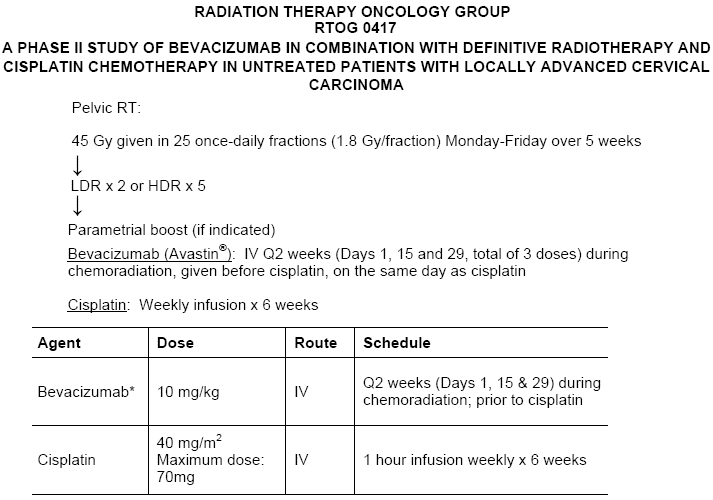
alone or in combination with cisplatin (40 mg per square meter of body-surface area once a
week for up to six doses; maximal weekly dose, 70 mg), followed in all patients by
adjuvant hysterectomy. Women with evidence of lymphadenopathy on computed tomographic
scanning or lymphangiography were ineligible unless histologic analysis showed that there
was no lymph-node involvement. The cumulative dose of external
pelvic and intracavitary radiation was 75 Gy to point A (cervical parametrium) and
55 Gy to point B (pelvic wall). Cisplatin was given during external radiotherapy, and
adjuvant hysterectomy was performed three to six weeks later.
Results. The relative risks of progression of disease and death among the 183 women
assigned to receive radiotherapy and chemotherapy with cisplatin, as compared with the 186
women assigned to receive radiotherapy alone, were 0.51 (95 percent confidence interval,
0.34 to 0.75) and 0.54 (95 percent confidence interval, 0.34 to 0.86), respectively. The
rates of both progression-free survival (P<0.001) and overall
survival (P=0.008) were significantly higher in the combined-therapy group at four years. In
the combined-therapy group there were higher frequencies of transient grade 3 (moderate)
and grade 4 (severe) adverse hematologic effects (21 percent, vs. 2 percent in the
radiotherapy group) and adverse gastrointestinal effects (14 percent vs. 5 percent).
Conclusions. Adding weekly infusions of cisplatin to pelvic radiotherapy followed by
hysterectomy significantly reduced the risk of disease recurrence and death in women with
bulky stage IB cervical cancers.
GOG 85 / SWOG 8695. Eligible
patients were women with locally advanced carcinoma of the cervix (FIGO stages IIB, III,
and IVA), who had undergone extraperitoneal lymph node sampling of the para-aortic lymph
nodes, as well as intraperitoneal exploration and intraperitoneal washings. Women
found to have intraperitoneal or para-aortic nodal disease were excluded from the trial.
1986-1990 386 patients / Regimen I: external beam (pelvis) and
intracavitary radiation therapy with 5-FU infusion and cisplatin (177 pts) Regimen
II: external beam (pelvis) and intracavitary radiation therapy with
hydroxyurea (191 pts) Patients on regimen I received intravenous cisplatin 50 mg/m2
on days 1 and 29, and intravenous 5-FU 1000mg/m2/day on days 2,3,4,5,30,31,32, and 33
during external beam radiotherapy. Patientso n regimen II received oral hydroxyurea 80
mg/kg twice a week during external beam radiotherapy. Radiotherapy, identical for both
arms, was delivered with either AP or PA parallel ports or a four-field box technique.
Patients with stage IIB tumors received 4080 cGy external beam therapy, followed by 4000
cGy to point "A" via 1-2 intracavitary implants. If necessary, a parametrial
boost was given to bring the point "B" dose to 5500 cGy. Patients with stage III
or IVA disease were treated with 5100 cGy external beam radiotherapy, followed by 3000 cGy
to point "A" via 1-2 intracavitary implant and 6000 cGy to point "B"
from both sources, with or without a parametrial boost. Further details on chemotherapy
and radiotherapy are available in the reference manuscript.
GOG Protocol 85 Results The median follow-up for survivors is 8.4 years. The three-year survival rate for women on the cisplatin-5FU arm is 67%,
compared to 57% for women on the hydroxyurea arm. This difference is
statistically significant. GOG Protocol 85 Conclusions These results demonstrate that
concurrent radiation therapy and chemotherapy with cisplatin and 5FU result in improved
survival compared to concurrent radiation therapy with hydroxyurea for women with stages
IIB, III, and IVA cervical cancer.
SWOG 8797 /GOG 109, RTOG 9112 Eligible
patients were women with FIGO stages IA2, IB, and IIA carcinoma of the cervix, found to
have metastatic disease in the pelvic lymph nodes, positive parametrial involvement, or
positive surgical margins at time of primary radical hysterectomy with total pelvic
lymphadenectomy. Patients must have had confirmed negative para-aortic lymph
nodes. If the para-aortic lymph nodes were not sampled, then the patients must have had
confirmed negative common-iliac lymph nodes.1992-1996 243 patients Regimen I: external beam (pelvis) radiation therapy with cisplatin and 5-FU infusion
(127 pts) Regimen II: external beam (pelvis) radiation therapy (116 pts) Patients
on regimen I received intravenous cisplatin 70 mg/m2 followed by a 96-hour continuous
intravenous infusion of 5-FU (400 mg/m2) every three weeks for 4 courses. Radiotherapy,
identical for both arms, delivered 4930 cGy to the pelvis via
a four-field box technique. Patients with metastatic disease in the high common-iliac
nodes also received 4500 cGy to a para-aortic field.
SWOG Protocol 8797 Results The median follow-up for survivors is 43 months. The three-year survival rate for women on the adjuvant cisplatin/5-FU plus
radiation arm is 87%, compared to 77% for women onv the adjuvant radiation alone arm.
This difference is statistically significant. Conclusions These results demonstrate that
concurrent radiation therapy and chemotherapy with cisplatin and 5-FU compared to
radiation alone results in improved survival for women with FIGO stages IA2, IB, and IIA
disease found to have metastatic disease in the pelvic lymph nodes, positive parametrial
extension, or positive surgical margins. |