Concurrent Chemotherapy and Pelvic Radiation Therapy Compared With Pelvic Radiation Therapy Alone as Adjuvant Therapy After Radical Surgery in High-Risk Early-Stage Cancer of the Cervix SWOG 8797 /GOG 109, RTOG 9112
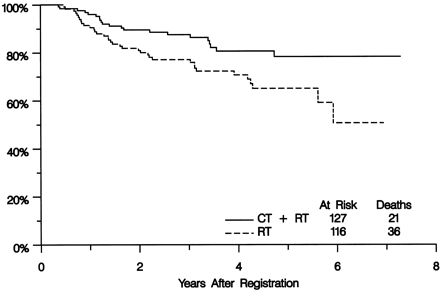
By Patients with clinical stage IA2, IB, and IIA carcinoma of the cervix, initially treated with radical hysterectomy and pelvic lymphadenectomy, and who had positive pelvic lymph nodes and/or positive margins and/or microscopic involvement of the parametrium were eligible for this study. Patients were randomized to receive RT or RT + CT. Patients in each group received 49.3 GY RT in 29 fractions to a standard pelvic field. Chemotherapy consisted of bolus cisplatin 70 mg/m2 and a 96-hour infusion of fluorouracil 1,000 mg/m2/d every 3 weeks for four cycles, with the first and second cycles given concurrent to RT. Patients were randomized to either pelvic RT or pelvic RT with four cycles of CT. The RT consisted of 1.7 Gy per day on days 1 to 5 of each week, for a total of 29 fractions (49.3 Gy). Pelvic RT was given to a standard four-field box. Patients with positive high common iliac lymph nodes also received treatment to a paraaortic field with a dose of 1.5 Gy per day on days 1 to 5 of each week, for a total of 30 fractions (45 Gy). The radiation source for treatment was 4 MeV or more. The radiation fields were reviewed by the Radiation Physics Center of M.D. Anderson Cancer Center (Houston, TX). It is important to note that brachytherapy was not permitted. For patients randomized to CT, treatment was begun on day 1 of their RT. One cycle of CT consisted of cisplatin 70 mg/m2 by 2-hour intravenous infusion given on day 1 and 5-FU at a dose of 1,000 mg/m2 per day for 4 days given as a 96-hour continuous infusion on days 1 to 4. The second cycle of CT began on day 22. The third and fourth cycles of CT were scheduled after completion of RT, to begin on days 43 and 64. Toxicity was defined by standard SWOG criteria. RESULTS: Between 1991 and 1996, 268 patients were entered onto the study. Two hundred forty-three patients were assessable (127 RT + CT patients and 116 RT patients). Progression-free and overall survival are significantly improved in the patients receiving CT. The hazard ratios for progression-free survival and overall survival in the RT only arm versus the RT + CT arm are 2.01 (P = .003) and 1.96 (P = .007), respectively. The projected progression-free survivals at 4 years is 63% with RT and 80% with RT + CT. The projected overall survival rate at 4 years is 71% with RT and 81% with RT + CT. Grades 3 and 4 hematologic and gastrointestinal toxicity were more frequent in the RT + CT group. CONCLUSION: The addition of concurrent cisplatin-based CT to RT significantly improves progression-free and overall survival for high-risk, early-stage patients who undergo radical hysterectomy and pelvic lymphadenectomy for carcinoma of the cervix. Overall survival for 127 patients randomized to receive CT + RT and for 116 patients randomized to receive RT alone. |
|
|