|
|
|
|
|
|






Cervix Cancer
the best, current advice on treating cervix cancer is
from the NCCN
here
|
|
|
|
|
|
Cervix Cancer
the best, current advice on treating cervix cancer is
from the NCCN
here
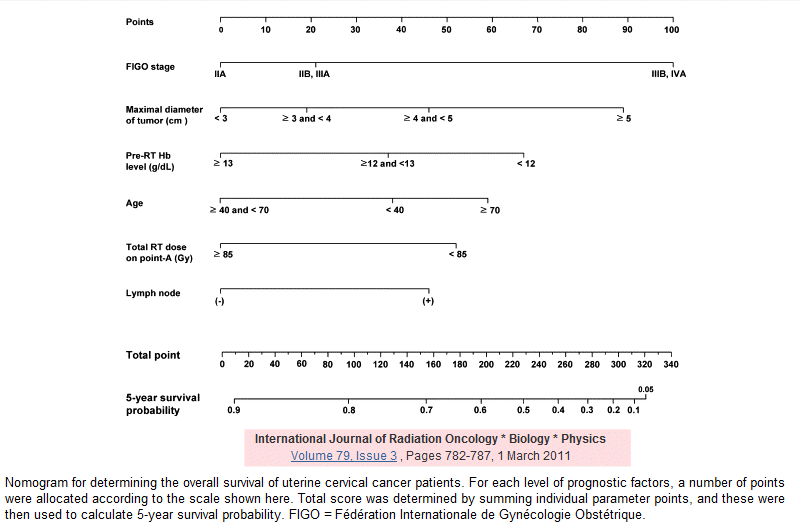
Premalignant Disease The well-described premalignant state of carcinoma of the cervix is variously called cervical intraepithelial neoplasia or squamous intraepithelial lesions. These lesions can be detected by cervical cytology (the Papanicolaou staining test), the most effective screening test for cancer. The transition from mild to severe dysplasia and carcinoma in situ to frankly invasive cancer may take years, permitting early diagnosis and cure for most patients. Malignant Disease The most important prognostic factor for invasive disease is the extent of disease at diagnosis Evaluation of patients to determine extent of disease should include a careful history and physical examination (including pelvic and rectal examination), complete blood count, tests reflecting hepatic and renal status, urinalysis, flexible sigmoidoscopy, barium enema, intravenous pyelogram, and CT scan of the abdomen and pelvis. Histologic diagnosis is mandatory through one or more of the following: cytologic smears, colposcopy, conization, punch biopsy specimens of four quadrants of the cervix, and dilation and curettage. The extent of the work-up may vary, but sufficient information to accurately stage the disease must be obtained. Management of limited disease Limited disease includes that confined to the cervix with invasion no deeper than 5 mm from the base of the epithelium and horizontal spread no greater than 7 mm (stages 0, IA1 and IA2). Definitive treatment is total abdominal hysterectomy. Selected patients (with carcinoma in situ or minimal invasion < 1 mm in depth) can be treated with more conservative measures, such as conization if all margins are clear. Patients who are not candidates for surgery may be treated with radiation alone. Management of locoregionally advanced disease Locoregionally advanced disease includes stages IB to IVA with or without involved para-aortic nodes. Definitive therapy for patients with stage IB or IIA disease consists of either pelvic radiotherapy or radical hysterectomy, both of which yield 5-year survival rates exceeding 80%. For those patients with bulky lesions (> 4 cm or barrel shaped), combined chemoradiation (radiation plus concurrent weekly cisplatin) yields results superior to those achieved with radiation therapy alone Current research evaluates alternative combined-modality regimens (surgery preceded by platinum-based chemotherapy, ie, neoadjuvant chemotherapy)' For patients with stage IIB, III, or IVA disease, randomized trials support the enhanced efficacy of concomitant cisplatin-based chemotherapy and radiation. Acceptable chemotherapy regimens include weekly cisplatin or cisplatin plus 5-fluorouracil. Five-year survival, depending on stage, ranges from 14% to better than 60%. For patients with involved para-aortic lymph nodes, survival is poor. The standard approach is radiation therapy with port extension to include the para-aortic node area. Five-year survival rates are approximately 10% to 15%. Management of advanced or recurrent disease Stage IVB or recurrent disease requires systemic therapy. Five systemic agents yield response rates approximating 20%: the platinum compounds, ifosfamide, dibromodulcitol, doxorubicin, and paclitaxel. Most trials of combination chemotherapy are uncontrolled studies in selected patients; hence, interpretation is difficult. One notable exception is the Gynecologic Oncology Group trial comparing cisplatin alone with combinations of cisplatin plus ifosfamide and cisplatin plus dibromodulcitol. This study demonstrated superiority for the ifosfamide plus cisplatin combination with respect to response rate and progression-free survival and is currently the regimen of choice. Ongoing or recently completed trials compare ifosfamide plus cisplatin with the same two drugs plus bleomycin and paclitaxel plus cisplatin with cisplatin alone. Current standard therapy is cisplatin plus ifosfamide, with an overall response rate of 33%, a clinical complete response rate of 20%, and a median response duration in excess of 8 months. |
||