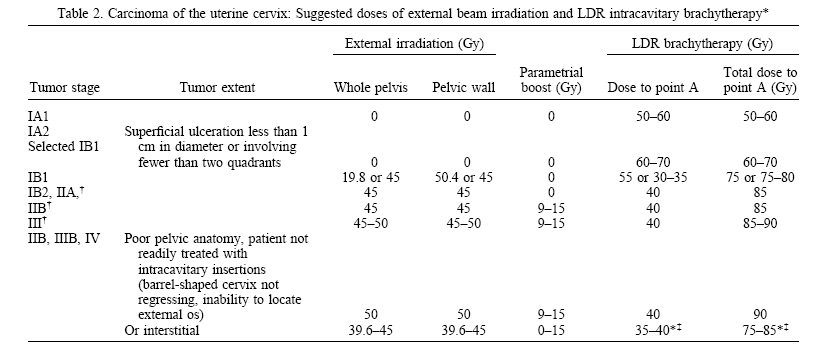
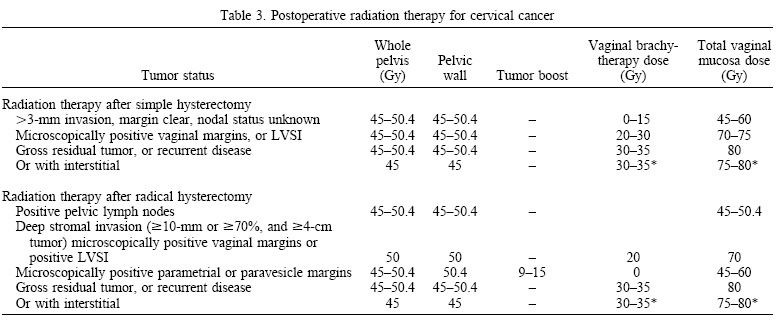
The ABS recommends completion of treatment within 8 weeks, when possible. Prolonging total treatment duration can adversely affect local control and survival. Recommendations are made for definitive and postoperative therapy after hysterectomy. Although recognizing that many efficacious LDR dose schedules exist, the ABS presents suggested dose and fractionation schemes for combining external beam radiotherapy with LDR brachytherapy for each stage of disease.
The dose prescription point (point A) is defined for intracavitary insertions. Dose rates of 0.50 to 0.65 Gy/h are suggested for intracavitary brachytherapy. Dose rates of 0.50 to 0.70 Gy/h to the periphery of the implant are suggested for interstitial implant. Use of differential source activity or loading minimizes excessive central dose rates.
The dose to the nominal rectal and bladder points should be kept as low as possible, although consistent with delivering appropriate tumor doses. Every effort should be made to keep the bladder dose to <90% of point A dose, the total bladder dose below 80 Gy, and the total rectal dose below 75 Gy