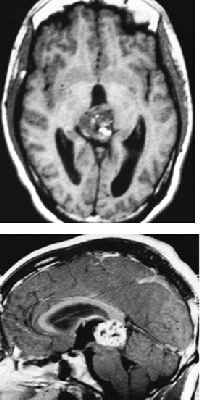
Stereotactic gamma radiosurgery for pineal and related tumors.
J Neurooncol 2001 Sep;54(3):301-9
Kobayashi T; Kida Y; Mori Y
Department of Neurosurgery, Gamma Knife
Center, Komaki City Hospital, Aichi pref., Japan
The role of gamma knife radiosurgery as an additional therapy after conventional
treatments for pineal and related tumors was studied in 30 of 33 tumors with a mean
follow-up of 23.3 months. Overall results showed that a complete response was obtained in
8 cases (26.7%) and the response rate was 73.3%. However, tumor progression was found in 8
cases (26.7%), of whom 7 (23.3%) died as a consequence. Germinoma and pineocytoma showed
higher response and control rates (100%), and neither progression nor death occurred after
gamma knife treatment. Germinoma with syncytiotrophoblastic giant cells (STGC) has been
thought to have an intermediate prognosis. Two of our cases showed a partial response and
another progression. Malignant germ cell tumor and pineoblastoma showed unfavorable
responses and prognosis, with the response and progression rates both being 50%. Gamma
knife radiosurgery was the initial treatment in three pineal tumor cases without a
histological diagnosis, and one complete and two partial responses were obtained. Gamma knife radiosurgery is expected to be an effective and novel
approach to pineal and related tumors, not only as an adjuvant but also as an initial
treatmentOperative approaches to the pineal region tumors
Childs Nerv Syst 1998
Jan-Feb;14(1-2):49-52 Fukui M; Natori Y; Matsushima T; Nishio S;
Ikezaki K
Department of Neurosurgery,
Neurological Institute, Kyushu University, Fukuoka, Japan.
Until the introduction of microsurgery,
the surgical treatment of pineal region tumors had very poor results with high mortality
and morbidity. However, there have been remarkable improvements
with modern surgical technology and advanced knowledge. Now the main surgical
approaches to pineal region tumors are the occipital transtentorial approach and the
infratentorial supracerebellar approach. Recently the neuroendoscopic approach has been
added. The surgical approach and any supplementary treatment should be selected in each
case according to the nature of the individual tumor. The forms of treatment practiced by
ourselves, including neuroendoscopic surgery, are presented, and the surgical treatments
now applied are discussed.
Radiation therapy for histologically
confirmed primary central nervous system germinoma.
Haddock MG, Schild SE, Scheithauer BW, Schomberg PJ. Int J Radiat Oncol Biol
Phys 1997 Jul 15;38(5):915-23
Division of Radiation Oncology, Mayo Clinic and Mayo Medical School, Rochester, MN 55905,
USA.
Data regarding 48 patients with histologically confirmed, primary central nervous system
germinoma were reviewed. All had been operated on at the Mayo Clinic between the years
1935 and 1993. Thirty-two patients (67%) were treated since 1973. The study group included
39 males and 9 females, with a median age at diagnosis of 17 years (range, 6-42 years).
Twelve patients (25%) were treated with craniospinal axis irradiation, 11 (23%) received
whole-brain irradiation without spinal axis irradiation, and 24 (50%) underwent
partial-brain irradiation. Treatment volumes were unknown in one patient. The median dose
to the primary tumor was 44.00 Gy (range, 7.44-59.40 Gy). The
median follow-up was 5.5 years (range, 4 months to 37 years). RESULTS: Actuarial 5-year
and 10-year survival for the entire study group of patients was 80%. There was a trend
toward improved survival in patients treated after 1973 (introduction of computed
tomography) with 5-year and 10-year survival of 91% vs. 63% in prior years (p = 0.07). For
the group of 31 patients treated since 1973 with known treatment volumes, the spinal axis
failure rate at 5 years was 49% for patients treated with partial brain fields (11
patients) vs. 0% for those having undergone whole brain (10 patients) or craniospinal axis
(10 patients) irradiation (p = 0.007). The rate of brain failure was also significantly
higher in patients receiving less than whole-brain irradiation; at 5 years, 45% of the
patients treated with partial-brain fields had intracranial recurrence of disease compared
to 6 % of patients treated with craniospinal axis or whole-brain irradiation (p = 0.01).
Among the 32 modern era patients, the rate of brain failure was higher in patients who
received doses less than 40 Gy (median dose, 48.55 Gy; range, 30.60-59.40 Gy) to the
primary tumor (5-year brain failure rate 52% vs. 11%, p = 0.002). CONCLUSION: The
long-term survival of patients with histologically proven CNS germinoma treated with
radiation is excellent. Whole-brain or craniospinal axis
irradiation appears to result in fewer spine and brain failures than does partial-brain
irradiation. Furthermore, the administration of doses greater than 40 Gy to the primary
tumor is associated with better local control.
Malignant pineal parenchymal tumors in
adult patients: patterns of care and prognostic factors.
Lutterbach J, Fauchon F, Neurosurgery 2002 Jul;51(1):44-55
Abteilung Strahlenheilkunde, Radiologische Universitatsklinik, Freiburg im Breisgau,
Germany. l
OBJECTIVE: The aim of our study was to analyze patterns of care and to identify prognostic
factors in patients at least 18 years of age who received radiotherapy for malignant
pineal parenchymal tumors. METHODS: In a multicenter, retrospective study, we analyzed
data for 37 previously published cases and 64 patients treated at the participating
institutions. RESULTS: A total of 56 patients received postoperative radiotherapy, and 45
patients received primary radiotherapy. Chemotherapy was administered to 34 patients. The
median follow-up period was 38 months, and median overall survival was 100 months. The
variables that significantly influenced overall survival were the extent of disease
(localized versus disseminated; P = 0.0002), differentiation (pineal parenchymal tumor of
intermediate differentiation versus pineoblastoma; P = 0.001), and residual disease (>
or = 50% versus < 50% reduction in size; P < 0.0001). In a multivariate analysis,
the parameters turned out to be independent risk factors. The median survival in patients
with local or spinal failure was 15 months. Local control was better in older patients
(> or = 32 yr versus < 32 yr; P = 0.02). Spinal control was more successful in
patients with pineal parenchymal tumors of intermediate differentiation than it was in
patients with pineoblastomas (P = 0.03). Nine of 45 treatment failures occurred later than
5 years after treatment. CONCLUSION: Stage, histological characteristics, and response are
independent risk factors in adults with malignant pineal parenchymal tumors. Late relapses
are common.
Histologically confirmed pineal tumors and
other germ cell tumors of the brain.
Schild SE, Scheithauer BW, Haddock MG, Wong WW, Lyons MK, Marks LB, Norman MG, Burger
PC. Cancer 1996 Dec 15;78(12):2564-71
Department of Radiation Oncology, Mayo Clinic Scottsdale, Arizona 85259, USA.
BACKGROUND: This study examined the outcome of patients with histologically confirmed
pineal region tumors. METHODS: One hundred thirty-five patients with
histologically confirmed pineal tumors and other germ cell tumors of the brain were
evaluated retrospectively. The pineal parenchymal tumors (PPTs) included 15
pineoblastomas (PB), 2 mixed PPTs, 4 PPTs with intermediate differentiation, and 9
pineocytomas. The germ cell tumors included 48 germinomas, 26 mixed germ cell tumors, 11
mature teratomas, 9 immature teratomas, 6 malignant teratomas, 2 yolk sac tumors, and 3
choriocarcinomas. Patients were treated with various combinations of chemotherapy,
radiotherapy, and surgery. The duration of follow-up ranged from 0.25 to 37.3 years, with
a median follow-up of 5.3 years. RESULTS: The 5-year patient
survival rate was 86% for those with mature teratomas; 86% with pineocytomas; 80% with
germinomas; 67% with immature teratomas; 49% with PPTs, excluding pineocytomas; 38% with
mixed germ cell tumors; and 17% with other germ cell histologies (P = 0.0001). The
delivery of > 44 Gray (Gy) to germinomas and > 50 Gy to PPTs and nongerminomatous
germ cell tumors (NGGCTs) other than mature and immature teratomas was associated with
improved survival. A greater extent of resection was associated with a higher
rate of survival in all patients with NGGCTs. The administration of chemotherapy was
associated with improved survival in those patients with NGGCTs other than mature and
immature teratomas. CONCLUSIONS: Prognosis was dependent on tumor type. Obtaining a tissue
diagnosis made it possible to tailor therapy according to tumor type and potentially
improve the survival of patients. Survival was dependent on the dose of radiation
administered to patients with PPTs, germinomas, and NGGCTs other than mature and immature
teratomas. More extensive resection and the use of chemotherapy were also associated with
improved survival in subgroups of patients with NGGCTs. Treatment recommendations are
described in detail in the article.
Pineal parenchymal tumors. Clinical,
pathologic, and therapeutic aspects.
Schild SE, Scheithauer BW, Schomberg PJ, Hook CC, Kelly PJ, Frick L, Robinow JS,
Buskirk SJ. Cancer 1993 Aug 1;72(3):870-80
Section of Radiation Oncology, Mayo Clinic Jacksonville, Florida.
BACKGROUND. Pineal parenchymal tumors are rare; therefore, only limited clinical data
regarding their behavior is available. This study was performed to provide further
information regarding the pathologic features, clinical behavior, and response to therapy
of these tumors. METHODS. This study includes data concerning 30 patients (15 male and 15
female patients) with pineal parenchymal tumors (PPT) diagnosed between 1939 and 1991.
Based on gross and microscopic features, tumors were divided into four groups:
pineocytomas (9); PPT with intermediate differentiation (4); mixed PPT exhibiting elements
of both pineocytoma and pineoblastoma (2); and pineoblastomas (15). At the time of
diagnosis, four patients had evidence of spinal seeding (two with pineoblastoma, two with
PPT with intermediate differentiation). Twenty-two patients received radiation therapy
(RT): 6 were treated to local fields, 7 to the whole brain, and 9 to the craniospinal
axis. RESULTS. For patients who received RT and had a minimum follow-up of 6 months, local
failure occurred in one of four patients with pineocytomas, zero of four patients with PPT
with intermediate differentiation, one of two with mixed PPT, and four of nine (44%) with
pineoblastomas. In patients receiving > or = 50 Gy to the primary tumor, 0 of 12 had
local failure compared with 6 of 7 (86%) patients receiving lesser doses. Leptomeningeal
failure occurred in zero of four patients with pineocytomas, zero of four patients with
PPT with intermediate differentiation, one of two with mixed PPT, and four of nine with
pineoblastomas. All leptomeningeal failures occurred in patients with persistent primary
tumor. Of the patients with seeding tumors (PPT other than pineocytomas) one of seven
(14%) developed leptomeningeal failure when treated with craniospinal irradiation,
compared with four of eight (50%) treated to lesser volumes. The projected 1-year, 3-year,
and 5-year survival rates of patients with pineocytomas were 100%, 100%, and 67%, and were
88%, 78%, and 58% for those with the other forms of PPT, respectively. CONCLUSIONS. RT
recommendations are described in detail and include the use of doses
of > or = 50 Gy to areas of gross disease and the administration of craniospinal
irradiation in patients with tumors prone to seeding. Surgical, chemotherapeutic,
and pathologic considerations are discussed.
Pineal and ectopic pineal tumors: the role of radiation
therapy.
Rao YT, Medini E, Haselow RE, Jones TK Jr, Levitt SH. Cancer 1981 Aug
1;48(3):708-13
Seventeen patients wih pineal tumors and one ectopic (suprasellar) germinoma were treated
with radiation therapy. Surgery was restricted to decompression in 16 patients, and only
two patients had resection of the tumor. Thirteen of 18 patients are alive without
evidence for disease with a ten-year survival rate of 88%. The tumor dose ranged from 4000
rads to 6000 rads. No age or dose dependence in survival was noted, but patients with
whole brain irradiation or generous volume to include ventricular system had better
survival. No case of spinal metastasis was noted. The possibility of increased incidence
of meningeal seeding following surgical intervention is considered. From their data, the
authors feel that radiation therapy with or without surgical decompression should be the
primary treatment for pinealoma. Surgery can be used for diagnosis and/or treatment of
patients who show delayed response to radiation. Recommendation is made for the use of whole brain irradiation to 4000 rads followed by a boost to the
tumor area to 5000 rads. |