Types of Breast Cancer     see distribution here

Today, most breast cancer is found at a relatively early stage -- when tumors are small and the disease is confined to the breast. Under these circumstances, nearly 97 percent of all affected women survive for at least five years.
The two main forms of breast cancer are:

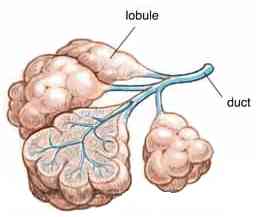
Invasive Ductal Carcinoma, which develops in the milk ducts, accounts for about 70 percent of cases. It can break through the duct wall and invade the breast's fatty tissue, and then metastasize to other parts of the body through the bloodstream or lymphatic system.

Invasive Lobular Carcinoma accounts for about 10 percent of all cases and originates in the breast's milk-producing lobes. It also can spread to the breast's fatty tissue and elsewhere in the body.
         

Less common forms of breast cancer include:

Three slow growing types usually detected on microscopic examination -- Medullary, Mucinous and Tubular Carcinomas. Together they represent about 12 percent of all breast cancers.

Paget's Disease, which comprises 1 percent of breast cancers, starts in the milk ducts and can spread to the areola, the dark circle around the nipple. Women who get Paget's usually have a history of nipple crusting, scaling, itching or inflammation.

Inflammatory Carcinoma accounts for 1 to 4 percent of all cases; it is the most aggressive and difficult to treat, since it spreads so quickly.

As more women have regular mammograms, doctors are detecting many more "non-invasive" or pre-cancerous conditions before they become full-blown cancer. Among them:

Ductal Carcinoma in Situ (DCIS) occurs when cancer cells fill the ducts but haven't yet spread through the walls into fatty tissue. Nearly all women diagnosed at this early stage can be cured. Once considered rare, DCIS now accounts for about 25,000 cases per year. Without treatment, about 25 percent of DCIS cases will lead to invasive breast cancer within 10 years. Because of this, DCIS is treated as if it were breast cancer-- with a mastectomy to remove the affected breast or a lumpectomy to remove the cluster of cancer cells. Both surgeries are followed by a course of radiation therapy to destroy any malignant cells that might remain in the breast.

Lobular Carcinoma in Situ (LCIS) is less common and less of a threat than DCIS. It develops in the breast's milk producing lobes and, when treated, doesn't progress to invasive cancer. However, it does increase a woman's risk of the disease: For every 1,000 women with LCIS, 7.2 will develop breast cancer within 30 years. Mysteriously, the cancer can occur in either breast -- not necessarily in the one with the LCIS. Because LCIS itself doesn't lead to cancer, no treatment is required; but affected women should be followed closely with mammograms and physician breast exams. Some women with LCIS opt for removing both breasts as a preventative measure. Since the overwhelming majority of women with LCIS never develop breast cancer, however, this drastic step is not generally recommended unless there are other significant risks, such as a strong family history of the disease.