


Home

Cancer

Cancer Types

Links

Site Map

Treating Glioblastoma


The truth is: there is no satisfactory treatment for glioblastoma! A recent update on understanding and treating glioblastoma is here. The current approach is combining new molecularly targeted drugs with radiation as noted here. Vaccine trials (immunotherapy)  are also showing promise go here. For instance one trial with dendritic cell vaccines pushed the median survival from 15 months to 26 months and another vaccine trial improved the 3 year survival from 3% to 37%.

.Patients generally have surgery and as much tumor as can be safely resected is removed. (See recent discussion of the limits of brain surgery here.)

This is followed by radiation (external beam to 60Gy) with or without chemotherapy (e.g. Temodar). See the current NCCN information here. New drugs are finally showing promise (go here) and there may be benefit from high dose Temodar (go here). A recent update on treatment is here.

The tumor invariably comes back. Because of this discouraging outcome, there are dozens of research trials going on, trying to improve the results with this cancer. (The recent RTOG trial combined weekly Taxol with XRT (60Gy) with no improvement in survival, median of 9.7 mos  Langer. IJROBP 2001;51:113.) A recent trial combined radiation with CCNU and Temodar with good results (go here). See the section on chemotherapy here

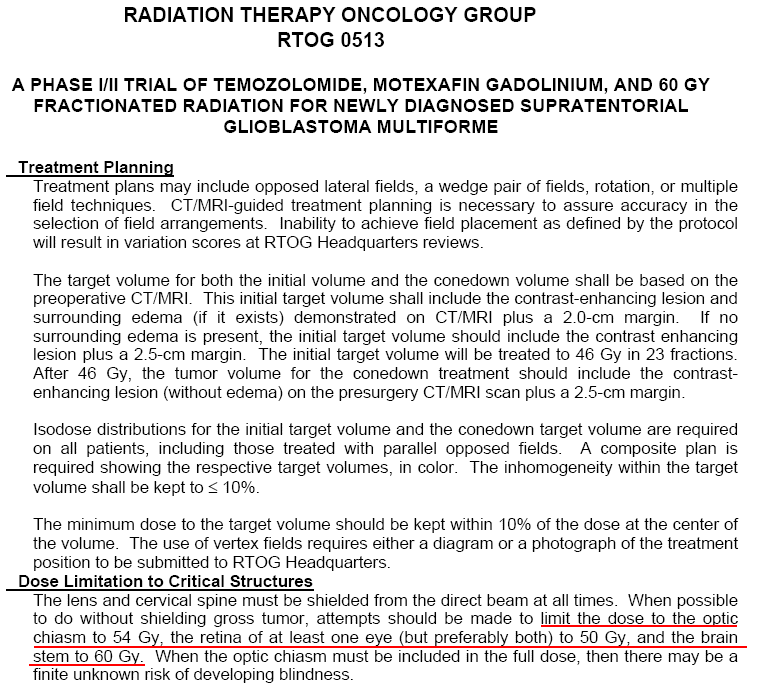
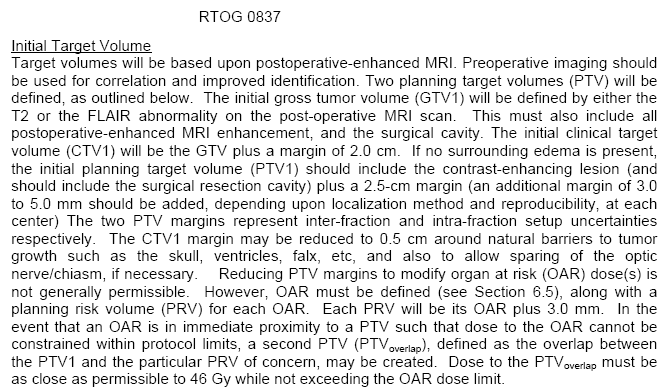
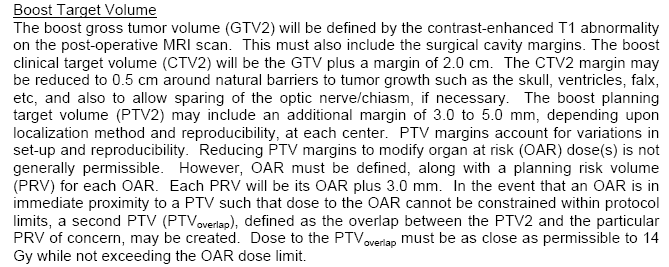
Typical dose schemes and port sizes from the RTOG are here are target advice from RTOG 0825 for PTV1 here and PTV2 here and dose limits here. Targets from RTOG 0837 are here and here. Other target information here.

To encompass infiltrating tumor cells, the RT dose (typically 60 Gy) is usually delivered to the tumor plus a margin of radiographically apparently normal tissue. If the tumor is defined based upon contrast enhancement, a margin of 2.0 to 3.0 cm is often used, while if the RT field is defined by T2-weighted MRI abnormality, a 1.0 to 2.0 cm margin is used.

Some current research ideas from the RTOG :

RTOG 0627 for recurrent GBM using dasatinib (a tyrosene kinase inhibitor)
RTOG 0625 for recurrent GBM comparing bevacizumab plus irinotecan or bevacizumab plus temozolomide
RTOG 0513 for GBM XRT (60Gy) plus Temozolomide plus Motexafin gadolinium
RTOG 0211 GBM XRT plus Iressa and go here

There is some benefit in treating glioblastoma with radiation even in the elderly (go here).  Oligodendroglioma is here


As noted by the NCI,

For patients with glioblastoma the cure rate is very low with standard local treatment.

Standard treatment options:

  1. Surgery plus radiation therapy and chemotherapy. A randomized cooperative study showed no additional benefit from brachytherapy added to external-beam radiation and carmustine (BCNU).
     
  2. Surgery plus radiation therapy.
     
  3. BCNU-impregnated polymer (Gliadel wafer) implanted during initial surgery. A randomized double-blinded controlled trial with 240 patients with high-grade glioma showed a survival advantage for patients who had BCNU-impregnated polymer placed intraoperatively at the time of initial surgery, compared with the placebo-treated group. The median survival was 13.9 months in the treated group and 11.6 months in the control group.
     
  4. A randomized study, published in abstract form, of radiation therapy versus radiation therapy plus temozolomide followed by 6 months of adjuvant temozolomide in patients with newly diagnosed glioblastoma multiforme demonstrated a statistically significant increase in median survival of 3 months in the combination-treated group. The 2-year survival rate was 26% in the combination group compared with only 8% in the radiation-only group. The treatment is relatively safe and well tolerated.

Treatment options under clinical evaluation:

  • Patients with brain tumors that are either infrequently curable or unresectable should be considered candidates for clinical trials that evaluate hyperfractionated irradiation, accelerated-fraction irradiation, stereotactic radiosurgery, radiosensitizers, hyperthermia, interstitial brachytherapy, or intraoperative radiation therapy used in conjunction with external-beam radiation therapy to improve local control of the tumor. These same patients are also candidates for studies that evaluate new drugs and biological response modifiers following radiation therapy.


 Review the current NCI trials for malignant gliomas and perform a literature search

setstats

 from the NCCN: The goals of surgery are to obtain a diagnosis, alleviate symptoms related to increased intracranial pressure or compression, increase survival, and decrease the need for corticosteroids. The mediansurvival with surgery alone is approximately 4 months. A prospectivestudy in patients with malignant glioma showed that extensive surgery was valuable compared to biopsy alone as a strong prognostic factor. Most studies suggest that the extent of resection lengthens survival and is especially effective in patients older than 50 years with glioblastoma multiforme and a Karnofsky performance score more than 70. Using current microneurosurgical techniques, it is possible to resect malignant gliomas in gross total fashion. An aggressive approach in which 98% or more of the tumor mass is resected results in a statistically significant survival advantage. Surgery also improves the outcome for patients with recurrent high grade astrocytomas.

Radiation is standard therapy for patients with high grade astrocytomas after either maximal excision or biopsy, based on a randomized trial conducted in the 1970s comparing postoperative supportive care, carmustine (BCNU), radiation, and radiation plus BCNU (Walker et al, 1978). Survival at 1 year was 3% with surgery alone, 12% with postoperative BCNU, and 24% with postoperative radiation. Currently, 60 Gy, divided into 30 to 36 fractions, is administered to the involved field. Alternative doses, fractions, and schedules have been explored without significant improvements.The role of focal radiation techniques in this diffusely infiltrative disease remains undefined.

Chemotherapy is of marginal value in patients with glioblastoma multiforme, but it may be more beneficial in younger patients and those with anaplastic astrocytomas.