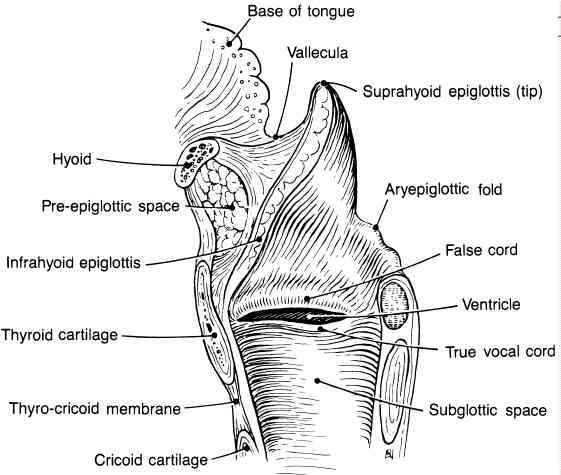
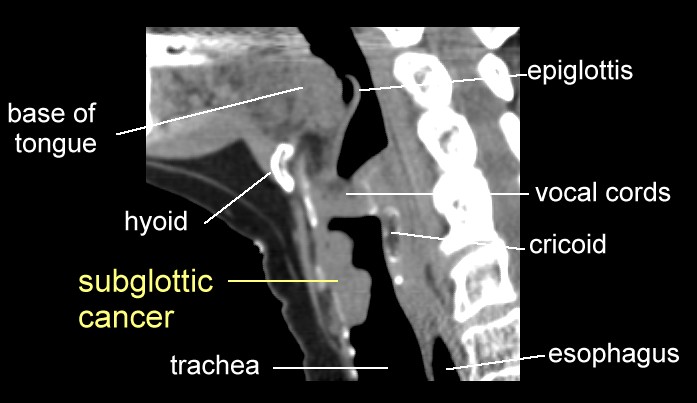
| Subglottic carcinoma accounts for less than 5
percent of all laryngeal cancers. Cancers of the subglottic region tend to invade
adjacent structures early in the course of their disease and are often quite extensive by
the time symptoms appear. Presenting symptoms include hoarseness from laryngeal invasion
and stridor from airway obstruction.The incidence of adenopathy at presentation varies
from 4 to 19 percent. The Delphian and pretracheal nodes are most commonly involved. Due
to the rarity of subglottic carcinomas, treatment has been based on institutional and
physician preference.
Shaha and Shah reported local control in 13 of 16 patients
treated with surgery. Three patients underwent partial laryngectomy, while the remaining
13 patients received a total laryngectomy. The overall cure rate at 5 years was 70
percent. Warde reported local control with radiation in 70 percent of 23 patients treated
at the Princess Margaret Hospital. The ultimate local control with surgical salvage was 74
percent. The cancers of all 12 patients with T1 to T3 lesions were controlled; however, in
only 4 of 11 patients with T4 lesions were the cancers controlled with radiation. The
5-year actuarial overall and determinate survival rates were 26 percent and 61 percent,
respectively.
Results of radiotherapy for primary subglottic squamous cell
carcinoma.
Paisley S, Warde PR, O'Sullivan B, Waldron J, Gullane PJ, Payne D, Liu FF, Bayley A,
Ringash J, Cummings BJ. Int J Radiat Oncol Biol Phys 2002 Apr 1;52(5):1245-50
Department of Radiation Oncology, Princess Margaret Hospital, University of Toronto,
Toronto, Ontario, Canada.
Primary subglottic cancer is uncommon, representing between 1% and 3.6%. To
retrospectively evaluate the outcome after radical radiotherapy (RT) and surgical salvage
and assess the risk of late toxicity for patients with primary subglottic squamous cell
carcinoma treated at our center. METHODS AND MATERIALS: Between 1971 and 1996, 43 patients
with primary squamous cell carcinoma of the subglottis (35 men, 8 women) were treated with
radical RT. All received megavoltage irradiation, most commonly to a dose of 50-52 Gy in
20 fractions during 4 weeks (39 patients). The median follow-up was 4.2 years. RESULTS:
Local control was achieved with RT alone in 24 (56%) of the 43 patients: 7 of 11 with T1,
8 of 12 with T2, 4 of 8 with T3, and 5 of 12 with T4. The 5-year actuarial local
relapse-free rate was 52%. Subsequent local control was achieved in 11 of the 13 patients
with failed RT and attempted surgical salvage, for an ultimate local control
rate of 81.4% (35 of 43). The 5-year overall and cause-specific actuarial
survival rate was 50.3% and 66.9%, respectively. No patients developed Grade 3 or 4 late
radiation morbidity.
An English-language Medline search of the literature from 1980 onward using the words
''subglottic'' and ''cancer'' yielded 15 treatment outcome studies involving
patients with primary subglottic cancer. Most of these reports anecdotally referred to 6
patients with subglottic cancer, focusing primarily on the outcome of glottic and
supraglottic cancers. Four reports, not including our own institution's 1987 study, were
found to be exclusively concerned with the outcome of treatment for primary subglottic
tumors Of these, the largest primary surgical series reported local
control in 11 of 15 patients.. In another study, local control was achieved for 5 of 13
patients treated with primary laryngectomy (one received postoperative RT), and for 4 of
10 patients treated with RT alone A third primary subglottic study reported 5-year
disease-free survival after surgery alone, RT alone, or combined treatment in 8 of 17, 0
of 6, and 15 of 18 patients, respectively . Similar results were observed in the largest
primary RT series, with overall disease control reported in 16 of the 23 patients . The literature of this disease is limited in the descriptions of
treatment and outcome. Given the rarity of this cancer, it is understandable that many
reports contained small numbers of cases, in which strong selection for different
approaches may exist.
Because delivery of radiation to the subglottic region is constrained by the anatomy of
the shoulders, it is imperative that proper attention be paid to the technique to attain
adequate disease coverage and tumor control. The ''angled down wedge pair'' technique,
frequently used in this series and in our practice for tumors with significant subglottic
extension, is used to achieve acceptable field margins around the diseased area,
particularly the inferior aspect of the tumor volume. Unless the patient has a
sufficiently long neck and can depress their shoulders adequately, a conventional opposed
lateral beam will likely result in a geographic failure at the inferior limit CONCLUSION: These data support the use of primary
RT in the treatment of patients with primary squamous cell carcinoma of the subglottis as
an appropriate treatment approach providing an option for laryngeal conservation.
Primary subglottic cancer: results of radical radiation therapy.
Guedea F, Parsons JT, Mendenhall WM, Million RR, Stringer SP, Cassisi NJ.
Int J Radiat Oncol Biol Phys 1991 Nov;21(6):1607-11
Department of Radiation Oncology, Hospital de la Santa Creu i Sant Pau, Universitat
Autonoma de Barcelona, Spain.
Between October 1964 and December 1985, six patients with primary squamous cell carcinoma
of the subglottis were treated with radical radiation therapy at the University of
Florida. The disease was staged as Tis (one patient), T2N0 (two patients), and T4N0 (three
patients). Local control was achieved with irradiation in four patients (66%) who were
observed for 3.5, 4, 4, and 5 years after radiation therapy. Two patients whose tumors
recurred at the primary site underwent salvage laryngectomy, which was successful in one
patient. |