Diet and breast cancer .
A review of the prospective observational studies
Michels. Cancer 2007;109:2712
The role of diet for the risk of
breast cancer is of great interest as a potentially modifiable risk
factor. The evidence from prospective observational studies was
reviewed and summarized on selected dietary factors, gene-diet
interactions, and breast cancer incidence. Dietary factors were
considered that, based on their nutritional constituents, are of
particular interest in the context of breast cancer: fat intake,
biomarkers of fat intake, fruit and vegetable consumption,
antioxidant vitamins (vitamins A, C, E, and beta-carotene), serum
antioxidants, carbohydrate intake, glycemic index and glycemic load,
dairy consumption (including vitamin D), consumption of soy products
and isoflavones, green tea, heterocyclic amines, and adolescent
diet. The PubMed database was searched for all prospective studies
that relate these dietary items to the incidence of breast cancer or
consider gene-diet interactions.
Among the prospective epidemiologic
studies conducted on diet and breast cancer incidence and gene-diet
interactions and breast cancer incidence,
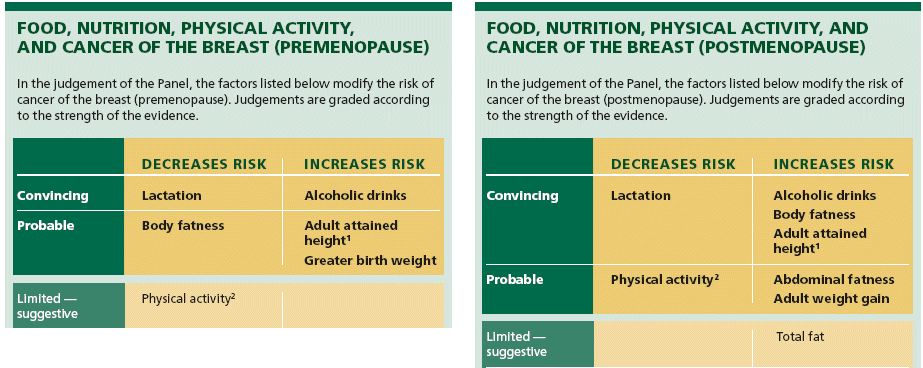
to date there is no
association that is consistent, strong, and statistically
significant, with the exception of alcohol intake, overweight, and
weight gain. The apparent lack of association between diet
and breast cancer may reflect a true absence of association between
diet and breast cancer incidence or may be due to measurement error
exceeding the variation in the diet studied, lack of sufficient
follow-up, and focus on an age range of low susceptibility.
The risk of breast cancer
can be reduced by avoidance of weight gain in adulthood and limiting
the consumption of alcohol.
Advancing science-based
approaches to breast cancer prevention
Susan G. Komen for the Cure
As an organization that promotes the
importance of evidence-based medicine, the Susan G. Komen for the
Cure is eager to see science yield more answers that will eventually
lead to new ways to prevent breast cancer. We have made progress in
the US in expanding life-saving access to breast cancer screening
and treatment but not in substantially reducing incidence. Many of
the identified risk factors, including family history of the
disease, age at menarche and menopause, parity, breast density, and
age at a first full-term pregnancy, cannot be readily modified.
Pursuing new evidence of risk factors that can be changed is a
crucial priority if we are to achieve our vision of a world without
breast cancer. The preliminary report this year that US breast
cancer incidence declined by 7% - 14,000 women - in 2003 and that
the drop may be due to reduced use of hormone replacement therapy[1]
reinforces our commitment to studies of other exogenous chemicals,
behaviors that affect hormones, and other factors with the potential
to significantly affect risk for many thousands of women.
To advance that goal, in 2004, Komen
commissioned the Environmental Factors and Breast Cancer Science
Review with Massachusetts-based Silent Spring Institute and their
collaborating partners at Harvard University, Roswell Park Cancer
Institute, and the University of Southern California to collect and
assess existing published scientific reports on possible links
between specific environmental factors and breast cancer. In its
first year the review targeted epidemiologic studies on
environmental pollutants, dietary factors, body size, physical
activity, and interactions of these factors with various genetic
polymorphisms, and the group reviewed toxicology studies to identify
chemicals that cause mammary tumors in animals. Reviews are
currently under way on additional topic areas: the toxicology of
endocrine disruptors, perinatal and early life exposures,
nonhormonal pharmaceuticals, tobacco smoke, occupational exposures,
light at night, and psychological stress. Topics were chosen to
reflect areas of active research with particular promise for
identifying new opportunities for prevention.
The chief goal of the Silent Spring
Institute study was to evaluate published research to determine what
is known and what is not known about the possible link between
environmental factors and the incidence of breast cancer. Breast
cancer is an extremely complex disease, caused by the interaction of
multiple factors, including exposure to carcinogens, genetics,
various aspects of lifestyle, and income disparities, among many
others. These factors, coupled with the timing, dose, and duration
of harmful exposures, further complicate our understanding of and
ability to study an individual's risk for developing breast cancer.
Understanding the weight of evidence in this multifaceted area of
science can guide public information, public health policy, and
future research.
The outcomes of the Silent Spring
Institute study are of particular value to the scientific research
and public policy communities. The study provides:
 |
The most comprehensive, searchable database of potential
mammary carcinogens, based on animal studies, including a
list of 216 carcinogens and more detailed information on 97
with the most widespread exposure. |
|
|
A
searchable database containing summaries and critical
reviews of significant existing and ongoing epidemiologic
research regarding possible links between breast cancer and
diet, physical activity, body size, environmental
pollutants, and gene-environment interactions with these
factors. The critical review articles that integrate and
evaluate the results contained in the databases are included
in this special issue, and the databases are accessible
online at
www.komen.org/environment and
www.silentspring.org/sciencereview |
The study results are especially
useful in pointing out where there is consensus within the
scientific community on the relationship between environmental
factors and breast cancer and where additional research or improved
research methods are required. As an advocacy organization, Komen
has identified several core messages from the science that will
inform our work. The results provide consistent evidence to
reinforce the importance of physical activity and its potential to
lower a woman's risk of developing breast cancer. Conversely,
although alcohol consumption increases breast cancer risk, studies
of other aspects of diet do not currently support clear
recommendations related to breast cancer risk reduction. For
environmental pollutants, toxicologic studies raise concerns about a
large number of chemicals for which exposure is common; the
epidemiologic evidence is beginning to catch up, although this area
has received relatively little attention and gaps in our knowledge
remain.
The results underscore the need for
further research on the relation between dietary factors,
environmental pollutants, and breast cancer risk. As a direct
follow-up to the review, Komen announced a new
 Focused
Areas of Study Focused
Areas of Study program that will support at least $5 million in grants to develop
new environmental research methods. In addition, Komen continues to
fund environmental projects as part of its investigator-initiated
grants program, and Komen also supports and champions agencies such
as the National Cancer Institute (NCI), the Environmental Protection
Agency (EPA), and the National Institute of Environmental Health
Sciences (NIEHS) that continue to investigate the impact of the
environment on breast cancer incidence.
program that will support at least $5 million in grants to develop
new environmental research methods. In addition, Komen continues to
fund environmental projects as part of its investigator-initiated
grants program, and Komen also supports and champions agencies such
as the National Cancer Institute (NCI), the Environmental Protection
Agency (EPA), and the National Institute of Environmental Health
Sciences (NIEHS) that continue to investigate the impact of the
environment on breast cancer incidence.
|