Greater Survival After
Breast Cancer in Physically Active Women With High Vegetable-Fruit
Intake Regardless of Obesity
John P. Pierce
Journal of Clinical Oncology, Vol 25, No 17 (June 10), 2007:
pp. 2345-2351
Purpose: Single-variable analyses
have associated physical activity, diet, and obesity with
survival after breast cancer. This report investigates
interactions among these variables.
Patients and Methods: A prospective
study was performed of 1,490 women diagnosed and treated
for early-stage breast cancer between 1991 and 2000.
Enrollment was an average of 2 years postdiagnosis. Only seven
women were lost to follow-up through December 2005.
Results: In univariate analysis,
reduced mortality was weakly associated with higher
vegetable-fruit consumption, increased physical activity,
and a body mass index that was neither low weight nor
obese. In a multivariate Cox model, only
the combination
of consuming five or more daily servings of vegetables-fruits,
and accumulating 540+ metabolic equivalent tasks-min/wk
(equivalent to walking 30 minutes 6 d/wk), was associated
with a significant survival advantage (hazard
ratio, 0.56).
The approximate
50% reduction in risk
associated with these healthy lifestyle behaviors was
observed in both obese and nonobese women,
although fewer obese women were physically active with a
healthy dietary pattern (16% v 30%). Among those who adhered
to this healthy lifestyle, there was no apparent effect of
obesity on survival. The effect was stronger in women who
had hormone receptor–positive cancers.
Conclusion: A minority of breast
cancer survivors follow a healthy lifestyle that includes
both recommended intakes of vegetables-fruits and
moderate levels of physical activity. The strong protective
effect observed suggests a need for additional investigation
of the effect of the combined influence of diet and physical
activity on breast cancer survival. |
|
Dietary pattern and moderate
levels of physical activity (PA) have each been linked
separately to survival after breast cancer in some
but not all studies. Given that both diet and
PA have each been shown to modify circulating gonadal hormone
concentrations, their effect on survival after breast cancer
may not be independent, and combining both may provide the
optimal survival benefit. There is considerable scope for
improving dietary pattern and PA, given that only half of
breast cancer survivors report at least 9 metabolic
equivalent tasks (MET) -h/wk
and another half eat at least five daily servings of
vegetables-fruits (VF).
In this study, we examined the interactions between selected
lifestyle factors and mortality in breast cancer survivors who
might change lifestyle to improve prognosis. These women
volunteered for a diet trial within 4 years of diagnosis
and were randomly assigned to the comparison group of the
ongoing Women's Healthy Eating and Living Study. Our goal
was to establish a parsimonious set of lifestyle
predictors for use in the final analysis of the Women's
Healthy Eating and Living Study, which is investigating
the effect of a plant-based diet on additional breast cancer
events. First, we looked for univariate effects on survival
of lifestyle variables measured at baseline and, using only
variables with significant associations, we developed a
combined lifestyle variable. We tested the combined
variable in a multivariate model controlling for obesity
and cancer and treatment characteristics.
In these breast cancer survivors who
were interested in lifestyle change and were
predominantly nonsmokers,
the 30% of women who were physically active and consumed
at least 5 servings of vegetables and fruits each day had
an estimated 10-year mortality rate of 7%, approximately
half that of any other combination of PA and dietary
pattern. Of particular importance, this halving of risk
was seen in women who were not obese as well as in those
who were obese. Indeed, it appeared that both being
physically active and having a healthy dietary pattern
attenuated the increase in risk observed among the obese.
It was noted, however, that obese women were
approximately one half as likely as nonobese women to be
both physically active and to have a healthy dietary
pattern.
This study is not the first to
suggest that a combination of healthy lifestyle behaviors
is associated with improved survival, although it is the
first, to our knowledge, in a population of breast cancer
survivors. The European Healthy Aging study of 70- to
90-year-old men and women noted that being a nonsmoker,
adhering to a Mediterranean diet, being physically active, and
consuming alcohol in moderation were associated with a 60%
reduction in cancer deaths as well as 60% reduction in
all-cause mortality. Similarly, the Nurses' Health Study
noted that 82% of coronary events could be attributed to
lack of adherence to a similar combination of behaviors.
Longitudinal follow-up of a population-based random
survey of men and women in Hawaii demonstrated that a
combination variable constructed from smoking status, BMI, dietary
pattern, and alcohol use was strongly associated with
mortality, including mortality from cancer.
Accordingly, most recent guidelines for chronic
disease prevention, including cancer, cardiovascular
disease, and obesity, emphasize the importance of
adhering to multiple lifestyle behaviors. Given that the
number of cancer survivors is increasing, and breast cancer
survivors make up the largest group of cancer survivors,it
is important to consider the potential impact on prognosis of
lifestyle changes such as diet and PA on women who have
survived initial treatment.
PA recommendations usually include
duration (eg, 30 min/d), intensity (moderate, 3 to 6 METs;
vigorous, 6+ METs) and frequency (eg, vigorous, 3
times/wk; moderate, 5+ times/wk). Accordingly, the
absolute minimum recommendation for moderate activity would
require 450 MET-min/wk. In this study, we chose a level 20%
higher than this absolute minimum for classifying a
participant as physically active; this allowed us to use
an equivalent cut point to that used in the Nurses'
Health Study. However, unlike the Nurses' Health Study,
in the univariate analysis only, we found a significant
linear association in which
more activity was associated with increased benefit.
It is important to note that the brief self-reported
questionnaire has been shown to overestimate activity
when compared with an accelerometer measure in our study
population.
The survival advantage for
the high VF/high PA lifestyle was present in women who
had ER-positive tumors, but not in those who were
ER-negative, suggesting that the mechanism for action for
this effect might be reproductive gonadal hormones, as has
been suggested previously for each of the component lifestyle
factors. It is likely that this observed effect is not simply
an effect of adjuvant tamoxifen, which was prescribed to 45%
of the study sample. The effect observed may vary in current
populations because study participants were all diagnosed
before the introduction of adjuvant aromatase inhibitor
therapy.
In summary, breast cancer
survivors who consume a healthy diet and are physically
active may increase their years of survival after
diagnosis. Specifically, we have shown that those who
reported eating a minimum of 5 VF servings daily and
performing weekly PA equivalent to 30 minutes of walking
at a moderate pace for 6 days a week had a higher 10-year
survival rate than those who did not adhere to these
lifestyle practices. The improved survival rate was
observed in women who were obese as well as those who
were not obese. Adhering to these two health behaviors
reduced the probability of death in the follow-up period by
50%, whereas this effect was not seen if breast cancer
survivors were adherent to only PA or VF dietary pattern.
These findings suggest the need for additional study of
the combined protective effect of diet and PA on breast
cancer survival. |
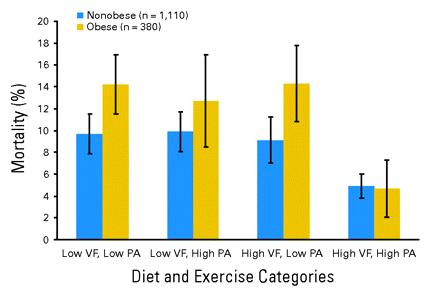
 5 servings/d; low PA, less than 540 metabolic equivalent
task (MET) -min/wk; high PA,
5 servings/d; low PA, less than 540 metabolic equivalent
task (MET) -min/wk; high PA,