Purpose: To perform a
retrospective analysis of patients
with paranasal sinus (PNS) cancer
treated with postoperative
radiotherapy (RT) at Memorial
Sloan-Kettering Cancer Center.
Methods and Materials:
Between January 1987 and July 2005,
85 patients with PNS and nasal
cavity cancer underwent
postoperative RT. Most patients had
squamous cell carcinoma (49%; n =
42), T4 tumors (52%; n = 36), and
the maxillary sinus (53%; n = 45) as
the primary disease site. The
median radiation dose was 63 Gy.
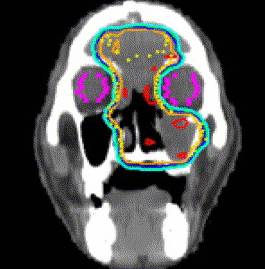
Of the 85 patients, 76 underwent CT
simulation and 53 were treated with
either three-dimensional conformal
RT (27%; n = 23) or
intensity-modulated RT (35%; n =
30). Acute and late toxicities were
scored according to the Radiation
Therapy Oncology Group radiation
morbidity scoring criteria.
Results: With a median
follow-up for surviving patients of
60 months,
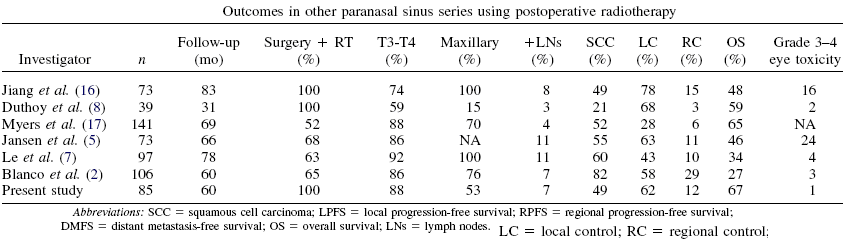
the 5-year estimates of local
progression-free, regional
progression-free, distant
metastasis-free, disease-free, and
overall survival rates were 62%,
87%, 82%, 55%, and 67%,
respectively. On multivariate
analysis, squamous cell histology
and cribriform plate involvement
predicted for an increased
likelihood of local recurrence, and
squamous cell histologic features
predicted for worse overall
survival.
None of the patients who underwent
CT simulation and were treated with
modern techniques developed a Grade
3-4 late complication of the eye.
Conclusion: Complete surgical
resection followed by adjuvant RT is
an effective and safe approach in
the treatment of PNS cancer.
Emerging tools, such as
three-dimensional conformal
treatment and, in particular,
intensity-modulated RT for PNS
tumors, may minimize the occurrence
of late complications associated
with conventional RT techniques.
Local recurrence remains a
significant problem.