|
|
|
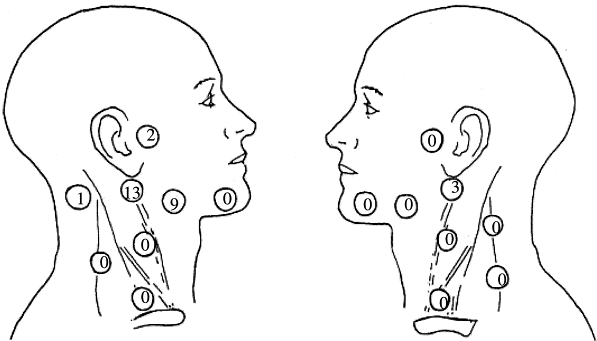
Pattern of nodal involvement either at diagnosis or on follow-up. |
|
|
|
Lymph node metastasis in
maxillary
sinus carcinoma
|
|
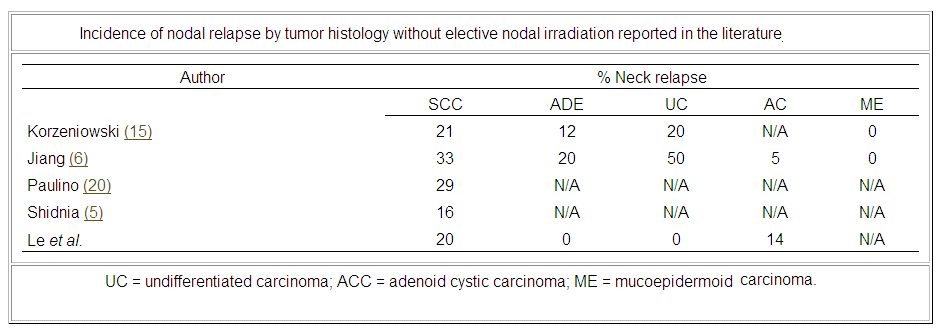
We reviewed the records of 97 patients treated for maxillary sinus carcinoma with radiotherapy at Stanford University and at the University of California, San Francisco between 1959 and 1996. Fifty-eight patients had squamous cell carcinoma (SCC), 4 had adenocarcinoma (ADE), 16 had undifferentiated carcinoma (UC), and 19 had adenoid cystic carcinoma (AC). Thirty-six patients had neck irradiation, 25 of whom received elective neck irradiation (ENI) for N0 necks.The median survival for all patients was 22 months (range: 2.4–356 months). The 5- and 10-year actuarial survivals were 34% and 31%, respectively. Ten patients relapsed in the neck, with a 5-year actuarial risk of nodal relapse of 12%. The 5-year risk of neck relapse was 14% for SCC, 25% for ADE, and 7% for both UC and ACC. The overall risk of nodal involvement at either diagnosis or on follow-up was 28% for SCC, 25% for ADE, 12% for UC, and 10% for AC. All patients with nodal involvement had T3–4, and none had T2 tumors. ENI effectively prevented nodal relapse in patients with SCC and N0 neck; the 5-year actuarial risk of nodal relapse was 20% for patients without ENI and 0% for those with elective neck therapy. There was no correlation between neck relapse and primary tumor control or tumor extension into areas containing a rich lymphatic network. The most common sites of nodal relapse were in the ipsilateral level 1–2 nodal regions (11/13). The 5-year actuarial risk of distant relapse was 29% for patients with neck control versus 81% for patients with neck failure. There was also a trend for decreased survival with nodal relapse. The 5-year actuarial survival was 37% for patients with neck control and 0% for patients with neck relapse. Conclusion: The overall incidence of lymph node involvement at diagnosis in patients with maxillary sinus carcinoma was 9%. Following treatment, the 5-year risk of nodal relapse was 12%. SCC histology was associated with a high incidence of initial nodal involvement and nodal relapse. None of the patients presenting with SCC histology and N0 necks had nodal relapse after elective neck irradiation. Patients who had nodal relapse had a higher risk of distant metastasis and poorer survival. Therefore, our present policy is to consider elective neck irradiation in patients with T3–4 SCC of the maxillary sinus. Carcinomas of the maxillary sinus are uncommon, with an annual incidence of < 1:100,000 in the United States. They comprise 0.2–0.5% of all cancers, 3% of all head and neck cancers, and 80% of all paranasal sinus cancers. In general, they represent a challenging therapeutic dilemma because of their rarity and proximity to critical structures. The incidence of primary nodal metastasis at presentation ranges from 3.3% to 26% Because of the general belief that nodal metastasis is uncommon in tumors without extensive lymphatic involvement, most authors have advocated no elective neck irradiation (ENI) for patients with maxillary sinus carcinoma. This long-held conviction has been recently challenged by Jiang and Paulino. Both authors advocated elective ipsilateral neck irradiation in patients with squamous cell carcinoma (SCC) due to the high incidence of neck relapse associated with this histology (28.9–33%) and the inferior survival of those who relapsed in the neck. At Stanford University (SUH) and at the University of California, San Francisco (UCSF), there has not been a uniform policy on the use of ENI for maxillary sinus carcinoma. The technique and the extent of neck irradiation has also varied depending on the treating physician and the period of treatment. To determine the incidence and the pattern of nodal relapse, its influence on the overall tumor control and survival, and the effectiveness of ENI in preventing nodal metastasis, we undertook a retrospective review of the patients treated definitively for maxillary sinus carcinoma at both institutions. Carcinoma of the maxillary sinus is a rare condition in the United States. Because of the tumor location and the lack of early symptoms, patients usually present with advanced disease, resulting in poor local control and survival. In recent years, with the use of combined modality therapy employing modern surgical and radiotherapeutic approaches and chemotherapy, investigators have noted an improvement in treatment results. With better local control, more attention is being paid to regional and distant metastases. Recently, some studies have demonstrated an association between tumor histology and the incidence of nodal relapse. Many have also shown poorer survival or disease-specific survival with regional failure. The issue of ENI for these tumors has been controversial. Fletcher, in their textbook, recommended ENI for patients with T3–4 tumors, a view supported by Bataini and Ennuyer. In contrast, others do not advocate ENI due to the low incidence of nodal failure, poor local control, and low survival rates in these patients. Recently, Jiang revisited the issue, and recommended ENI for patients with SCC and UC histologies based on a > 30% incidence of neck relapse in N0 patients when the neck is not treated. summary of the incidence of nodal relapse by tumor histology reported in the literature for maxillary sinus carcinoma when no ENI was given. In patients treated without ENI, Jiang reported a 33% risk of neck relapse for SCC, 50% for UC, and 5% for both AC and mucoepidermoid histologies. Patients with regional failure had an inferior 10-year disease-specific survival rate compared to those without (34% vs. 58%). Based on these findings, the authors advocated elective nodal treatment for patients with T2–4 squamous cell or UC. Korzeniowski noted a similar influence of histology on regional control. In their report, the frequency of nodal metastasis at presentation and during follow-up was 60% in patients with UC, 30% in patients with nonkeratinizing SCC, and 13% for patients with keratinizing SCC. They recommended ENI for the UC and nonkeratinizing SCC histology. More recently, Paulino reviewed 42 patients with SCC of the maxillary sinus treated at Loyola University with either radiotherapy alone or with combined surgery and radiotherapy. Of 38 patients with initial node-negative necks, 11 (28.9%) developed nodal relapse. Their analysis showed that only tumor stage was predictive of neck relapse with T1–2 cancers doing worse than T3–4. Tumor location (supra vs. infrastructure), extension to areas containing rich lymphatic networks, and local control were not significant prognostic factors for nodal relapse. They also noted an inferior median survival in patients with neck node metastases either on initial presentation or on follow-up when compared to those without nodal disease (25 months vs. 80 months). The authors, therefore, recommended elective ipsilateral neck irradiation for all patients with SCC of the maxillary sinus. In our study, the overall risk of neck relapse calculated by the Kaplan-Meier curve is 12% at 5 years, which is lower than observed in previous studies. However, 31% of the patients had ENI for N0 necks. We observed a higher incidence of neck involvement and neck relapse in patients with SCC and ADE histologies. The number of patients with ADE histology in the series was too small to draw definitive conclusions. As shown in all of the neck relapses were associated with T3–4 cancers, and ENI effectively prevented nodal relapse in patients with SCC histology. The most common sites of nodal relapse and initial nodal spread were ipsilateral level I–II neck nodes. Similar to previous reports, nodal metastasis at diagnosis and nodal relapse were associated with poor survival in this study. While 37% of patients with neck control were alive at 5 years, none of those with neck relapse were alive. We also observed a strong association between nodal relapse and the development of distant metastasis. In fact, nodal relapse was an independent prognostic predictor for distant tumor spread on multivariate analysis. Previous studies have suggested an increased risk of neck relapse with tumor extension into areas with rich lymphatic networks. More recently, this notion has been questioned by Paulino, who found no association between nodal relapse and tumor involvement of the nasal cavity, nasopharynx, oral cavity, and oropharynx. The results of the present series confirmed this lack of association, with the exception of a nonsignificant trend toward increased neck recurrence with nasopharyngeal involvement. Aside from the suggestion of increased nodal relapse with T3–4 tumors and SCC/ADE histologies, we also found no correlation between nodal relapse and either N-stage or local tumor control. In the present study, late complications related to neck therapy were rare. Only 1 of 36 patients receiving neck irradiation developed treatment-related toxicity (ipsilateral brachial plexopathy and severe neck fibrosis). This same patient also developed ipsilateral blindness and severe trismus from treatment of the primary site. Review of his treatment data showed appropriate tumor doses and dosimetry. It is possible that this patient, who was diagnosed with an UC at age 20, had a genetic abnormality in his DNA repair processes that increased his susceptibility to radiation damage. Unfortunately, fresh tissues from the patient are not available to analyze for such abnormality. A similar low rate of complications related to neck treatment was noted in the M. D. Anderson series (6). Nearly all of their described complications were secondary to treatment of the primary site. They noted one case of mandibular osteoradionecrosis secondary to ENI. Because most of the neck failures occurred in the ipsilateral level I and II lymph nodes both in the present study and in the study reported by Paulino, treatment toxicity may be minimized by considering elective radiation only to the ipsilateral upper neck. We recognize that this is a retrospective study with all of the potential inherent biases associated with this type of review. However, this is one of the larger series in this country with significant long-term follow-up for alive patients. Over half of the alive patients were followed for more than 5 years. Our data suggest that nodal relapse was strongly associated with a higher risk of distant metastasis and poorer overall survival. In addition, it can be effectively prevented with minimal morbidity by elective nodal irradiation in patients at high risk for regional failure. A multicenter prospective randomized study would be the best approach to evaluate the effectiveness of elective nodal irradiation in this setting; unfortunately, the rarity of these tumors would make it difficult for such a study to be completed in a timely fashion. Meanwhile, our treatment policy is to consider elective ipsilateral neck irradiation for patients with T3–4 SCC of the maxillary sinus. |
|
|
|
Pattern of nodal involvement either at diagnosis or on follow-up. |
|
|