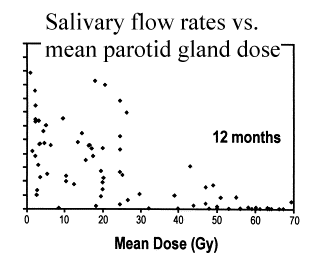
Dose, volume, and function
relationships in parotid salivary glands following conformal and
intensity-modulated irradiation of head and neck cancer
Eisburch. IJROBP 1999;45:577
To determine the relationships between
the three-dimensional dose distributions in parotid glands and their
saliva production, and to find the doses and irradiated volumes that
permit preservation of the salivary flow following irradiation (RT).
Saliva flow rates data were available for 152
parotid glands. Glands receiving a
mean dose below or equal to a threshold (24 Gy for the unstimulated and 26
Gy for the stimulated saliva) showed substantial preservation of the flow
rates following RT and continued to improve over time (to median
76% and 114% of pre-RT for the unstimulated and stimulated flow rates,
respectively, at 12 months). In contrast, most glands receiving a mean
dose higher than the threshold produced little saliva with no recovery
over time. The output was not found to decrease as mean dose increased, as
long as the threshold dose was not reached.
Similarly, partial volume
thresholds were found: 67%, 45%, and 24% gland volumes receiving more than
15 Gy, 30 Gy, and 45 Gy, respectively. The partial volume thresholds
correlated highly with the mean dose and did not add significantly to a
model predicting the saliva flow rate from the mean dose and the time
since RT. The NTCP model parameters were found to be TD50
(the tolerance dose for 50% complications rate for whole organ irradiated
uniformly) = 28.4 Gy, n (volume
dependence parameter) = 1, and m (the
slope of the dose/response relationship) = 0.18. Clinical factors
including age, gender, pre-RT surgery, chemotherapy, and certain medical
conditions were not found to be significantly associated with the salivary
flow rates. Medications (diuretics, antidepressants, and narcotics) were
found to adversely affect the unstimulated but not the stimulated flow
rates.
Conclusions: Dose/volume/function relationships in
the parotid glands are characterized by dose and volume thresholds, steep
dose/response relationships when the thresholds are reached, and a maximal
volume dependence parameter in the NTCP model.
A
parotid gland mean dose of ≤26 Gy should be a planning goal if substantial
sparing of the gland function is desired.
Changes in salivary gland function after radiotherapy of head and neck
tumors measured by quantitative pertechnetate scintigraphy: Comparison of
intensity-modulated radiotherapy and conventional radiation therapy with
and without Amifostine
Munter. IJROBP 2007;67:651
The aim of this study was to compare
changes in salivary gland function after intensity-modulated
radiotherapy (IMRT) and conventional radiotherapy (RT), with or without
Amifostine, for tumors of the head-and-neck region using quantitative
salivary gland scintigraphy (QSGS). A total of 75 patients received pre-
and post-therapeutic QSGS to quantify the salivary gland function. In
all, 251 salivary glands were independently evaluated. Changes in the
maximum uptake (ΔU) and relative excretion rate (ΔF) both pre- and
post-RT were determined to characterize radiation-induced changes in the
salivary gland function. In addition, dose–response curves were
calculated.
Results: In all groups, maximum uptake and relative excretion
rate were reduced after RT (ΔU ≤0 and ΔF ≤0). The
reduction was significantly
lower for IMRT than for conventional RT. For the parotid glands,
the reduction was smaller for the IMRT-low than for the IMRT-high group.
For the Amifostine-high and the conventional group the difference was
significant only for one parameter (ΔU, parotid and submandibular
glands, p < 0.05). In contrast to this, the difference between
the Amifostine-low and the conventional group was always significant or
at least showed a clear trend for both changes in U and F.
In regard to the endpoint
“reduction of the salivary gland excretion rate of more than 50%,” the
dose–response curves yielded D50-values
of 34.2 ± 12.2 Gy for the conventionally treated group and 36.8 ± 2.9 Gy
for the IMRT group. For the Amifostine group, an increased D50-values
of 46.3 ± 2.3 Gy was obtained.
Conclusion: Intensity-modulated RT can significantly reduce the
loss of parotid gland function when respecting a certain dose threshold.
Conventional RT plus Amifostine prevents reduced salivary gland function
only in the patient group treated with <40.6 Gy.
Aim of the inverse dose optimization process was the protection the
parotid glands. At least one parotid gland should receive a median dose
of <26 Gy. Sparing of both parotid glands was intended for all patients.
Protection of the submandibular glands was not intended.
Recently, different approaches have been
established to protect the salivary glands and to prevent xerostomia and
related side effects after radiotherapy.
Amifostine is widely used
as a radioprotector to reduce xerostomia and mucositis in the treatment of
head-and-neck cancer. The Phase III trial of Brizel supported the
capability of Amifostine for radioprotection in head-and-neck cancer and a
reduction of the incidence of acute xerostomia Grade 2 or higher was shown
to be reduced from 78% to 51%.
Late effect xerostomia Grade 2 or higher was reduced
from 57% to 34%. In this study, the outcome for both endpoints was
highly significant. A recent update of this study presented a follow-up of
2 years and showed that the incidence of Grade 2 or higher xerostomia is
still significantly reduced using Amifostine compared with the control
group without Amifostine. The authors furthermore stated that Amifostine
did not compromise locoregional control rates, progression-free survival,
or overall survival.
Buentzel et al. presented a randomized,
placebo-controlled, Phase III study comparing radiochemotherapy with and
without Amifostine for head-and-neck tumors. In this trial, Amifostine
could not reduce acute or late xerostomia. Xerostomia Grade 2 or higher
late xerostomia was 37% with and
24% without Amifostine respectively. These results are comparable
to the functional data after QSGS presented in our study. However it
should be mentioned that, in contrast to the study by Buentzel et al.,
the majority of the patients in our study received radiotherapy and not
radiochemotherapy.
For high radiation doses we could find only a
significant difference compared with that in the conventional treatment
group for the maximum uptake in the Amifostine group for the parotid and
submandibular glands together. Patients treated with
reduced total doses of <40.6 Gy plus Amifostine had a significantly better
functional outcome for ΔF
and ΔU
as compared with those in the conventional treatment group.
Higher doses of Amifostine might be necessary to
reduce toxicity in patients receiving therapy for primary and
postoperative disease. Experimental studies confirmed that the
cytoprotective effect of Amifostine is dose dependent. Several studies
with increased i.v. doses of Amifostine showed a significant effect. In
our study, the recommended standard dose of 200 mg/m2
Amifostine was i.v. administered, and an increased dose might have
improved the functional outcome of the salivary glands. Another important
aspect is the daily timing of Amifostine administration with respect to
the start of radiotherapy. A time frame of <30 min between administration
and radiotherapy is currently recommended.
For the endpoint “reduction of the relative
excretion rate of more than 50% (ΔF≤50%)” the
D50-value
of 44.3 Gy for the parotid glands in the Amifostine group was
significantly increased as compared with the IMRT and conventional
treatment group. This clearly demonstrates that the protective potential
of Amifostine for the salivary glands. In our study, however, no
significant functional sparing was found for high radiation doses plus
Amifostine, indicating that administration of Amifostine is effective only
if the radiation doses are not too large.
The D50-value
for the parotid glands in the IMRT group was 35.0 Gy. Kuhnt
presented a comparable D50-value of
36,9 Gy for the parotid
glands using stimulated saliva flow measurement. A recent study presented
a somewhat higher D50-value for the
parotid gland of 43 Gy. This value, however, was measured by salivary
gland scintigrapy at 1 year rather than 3 months.
The significantly increased D50-value
of the Amifostine group and the results of the patient group receiving
Amifostine and radiation doses of <40.6 Gy supports the conclusion that
the scavenging of radiation-induced free radicals by Amifostine can
protect the parotid glands below a certain dose threshold. For higher
doses, however, the dose–response curve increases and the parotid glands
are not spared anymore. Rades reported a large number of serious
adverse effects necessitating discontinuation of Amifostine treatment and
a delay in the radiotherapy course. If Amifostine is administered in a
daily routine, these adverse effects as well as the high treatment costs
should also be considered.
The
patients receiving IMRT for salivary gland protection had a significant
better functional outcome in almost all tested parameters in comparison to
the conventional and the Amifostine-high group. Besides this, a
significant better functional outcome for ΔF and ΔU was found, especially
for the parotid gland in the IMRT-low group (mean dose <26 Gy) as compared
with the IMRT-high group (mean dose ≥26 Gy).
Therefore, the preservation of the
salivary gland function as measured by QSGS
may be better achieved by using modern irradiation techniques such as IMRT
than by using the radio-protector Amifostine.
In the last few years, several studies have been
published that demonstrated the capability of IMRT in improving the dose
distributions for head-and-neck cancer. In particular the potential of
IMRT to protect the parotid glands has been shown. Attempts to preserve
the function of the salivary glands should not cause an increased
locoregional failure rate. This can be achieved by the high dose gradient
between the planning target volume and the parotid glands. Up to now,
increased local failure rates resulting from protection of the parotid
gland were not reported. In most cases at least one or both parotid glands
were protected to prevent xerostomia in the different published studies.
In a recent study by Saarilathi , the contralateral submandibular gland
was protected additional to the ipsi- or contralateral parotid glands.
Within a median follow-up of 31 months no locoregional failure was found
in the study of Saarilathi et al.
To spare the salivary glands, the dose should be
reduced as much possible without compromising the target coverage. In a recent
study by Eisbruch)
a threshold of 26 Gy for the mean dose to the parotid glands was proposed.
In our study, this threshold was used as planning goal. The mean dose
averaged over the protected parotid glands was 20.1 Gy in this study.
Mean doses of <20 Gy are currently
recommended by some investigators, for the parotid glands to receive the
best functional outcome. However it should be considered that such
an excellent protection might cause inadequate treatment of the directly
adjacent target volume, which may result in recurrent disease.
In conclusion, this retrospective
single-institution study compared two different concepts to prevent loss
of the salivary glands function. To our knowledge a direct comparison
between IMRT and conventional RT with and without Amifostine has not been
published yet. IMRT preserves the functional outcome measured by QSGS more
efficient than high conventionally delivered irradiation doses in
combination with Amifostine administration. Comparable results for the
Amifostine group was achieved only for salivary glands receiving mean
doses <40.6 Gy. From the presented data, it
can be concluded that Amifostine
increases the radiation tolerance of the salivary glands. IMRT, however,
seems to be the more effective treatment option to preserve the function
of the salivary glands and especially that of the parotid gland. The
strict dose threshold of 26 Gy, however, frequently cannot be achieved in
IMRT treatments. As Amifostine appears to be effective for doses <40.6 Gy,
it may be an additional therapeutic option to combine IMRT treatments with
the application of Amifostine. |