|
|
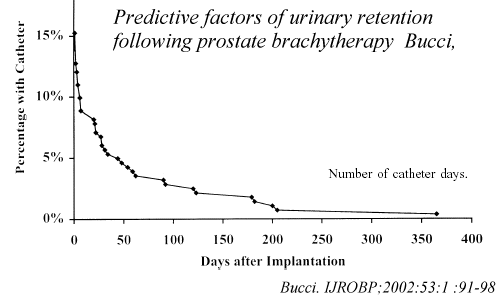
Seed Implant Retention Score Predicts the Risk of Prolonged Urinary Retention After Prostate BrachytherapyIJROBP Volume 76, Issue 5, Pages 1445-1449 (April 2010)To risk-stratify patients for urinary retention after prostate brachytherapy according to a novel seed implant retention score (SIRS).A total of 835 patients underwent transperineal prostate seed implant from March 1993 to January 2007; 197 patients had 125I and 638 patients had 103Pd brachytherapy. Four hundred ninety-four patients had supplemental external-beam radiation. The final downsized prostate volume was used for the 424 patients who had neoadjuvant hormone therapy. Retention was defined as reinsertion of a Foley catheter after the implant. ResultsRetention developed in 7.4% of patients, with an average duration of 6.7 weeks. On univariate analysis, implant without supplemental external-beam radiation (10% vs. 5.6%; p = 0.02), neoadjuvant hormone therapy (9.4% vs. 5.4%; p = 0.02), baseline α-blocker use (12.5% vs. 6.3%; p = 0.008), and increased prostate volume (13.4% vs. 6.9% vs. 2.9%, >45 cm3, 25–45 cm3, <25 cm3; p = 0.0008) were significantly correlated with increased rates of retention. On multivariate analysis, implant without supplemental external-beam radiation, neoadjuvant hormone therapy, baseline α-blocker use, and increased prostate volume were correlated with retention. A novel SIRS was modeled as the combined score of these factors, ranging from 0 to 5. There was a significant correlation between the SIRS and retention (p < 0.0001). The rates of retention were 0, 4%, 5.6%, 9%, 20.9%, and 36.4% for SIRS of 0 to 5, respectively. ConclusionsOne point was scored for each of the following: no supplemental external-beam radiation, neoadjuvant hormone therapy, baseline α-blocker use, or prostate size of 25–45 cm3. Two points were scored for prostate size >45 cm3 for having the highest rate of retention. There was a significant correlation between the SIRS and retention. The rates of retention were 0 of 30, 9 of 225 (4%), 17 of 303 (5.6%), 18 of 199 (9%), 14 of 67 (20.9%), and 4 of 11 (36.4%) for SIRS of 0 to 5, respectively The SIRS may identify patients who are at high risk for prolonged retention after prostate brachytherapy. A prospective validation study of the SIRS is planned. Risk
factors for acute urinary retention requiring temporary intermittent catheterization after
prostate brachytherapy: a prospective study We prospectively investigated prognostic factors for men undergoing transperineal radioactive seed implantation for prostate cancer at the University of Washington. Between February and April, 1998, 62 consecutive unselected patients were prospectively followed after brachytherapy for early-stage prostate adenocarcinoma. Pretreatment variables included age, American Urological Association (AUA) score, uroflowimetry, and prostate volume by ultrasound. Urinary retention rate at one week was 34% (21 of 63 patients). At one month, 29%; at three months, 18%; and at six months, 10%. Preoperative flow rate and post-void residual did not predict for retention (p = .48 and p = .58). Use of alpha blockers, hormonal therapy, type of seed (103Pd or 1251), or external beam radiotherapy had no impact on risk of retention at any followup point. Preimplant volume and AUA score predicted for retention on univariate analysis, but on multivariate analysis only postimplant volume remained significant (p = .02) for predicting retention risk and duration. Conclusion: Patients with large prostate size (>36 g) and
higher AUA score (>10) appear to be at greater risk of risk of retention as well as
duration of retention as defined in our study.| |