|
|
|
Survival in primary soft tissue sarcoma according to primary site Survival curves for different primary sites are based upon data from 3677 patients with soft tissue sarcoma evaluated at Memorial Sloan-Kettering Cancer Center, 1982-2001. Data from: Borden, EC, Baker, LH, Bell, RS, et al. Soft tissue sarcomas of adults: State of the translational science. Clin Cancer Res 2003; 9:1941. |
|
|
|
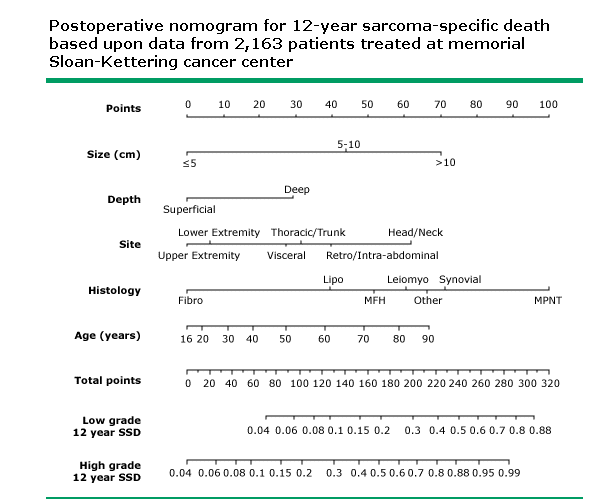
Instructions for physician: Locate the patient's tumor size on
the Size axis. Draw a line straight upwards to the Points axis to
determine how many points towards sarcoma-specific death the patient
receives for tumor size. Repeat this process for the other axes, each
time drawing straight upward to the Points axis. Sum the points achieved
for each predictor, and locate this sum on the Total Points axis. Draw a
line straight down to either the Low Grade or High Grade axis to find
the patient's probability of dying from sarcoma within 12 years assuming
he or she does not die of another cause first.
Instructions to patient: "If
we had 100 patients exactly like you, we would expect between (predicted
percentage from nomogram - 8 percent) and (predicted percentage + 8
percentage) to die of sarcoma within 12 years if they did not die of
another cause first. Death from sarcoma after 12 years is still
possible."
Fibro: fibrosarcoma; Lipo: liposarcoma; Leiomyo: leiomyosarcoma; MFH: malignant fibrous histiocytoma; MPNT: malignant peripheral-nerve tumor; SSD: sarcoma-specific death. Reproduced with permission from: Kattan, MW, Leung, DHY, Brennan, MF. Postoperative nomogram for 12-year sarcoma-specific death. J Clin Onc 2002; 20:791. Copyright © 2002 American Society of Clinical Oncology.
|