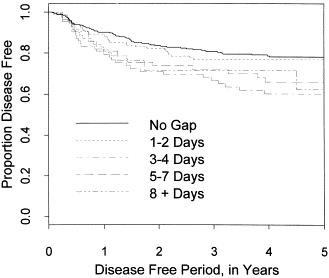
Results:
Unplanned gaps in treatment
are associated with poorer local control rates and an increased
hazard of a local recurrence through their effect on extending the
treatment time. A gap of 1 day is potentially damaging but the
greatest effect is at treatment extensions of 3 or more days, where
the hazard of a failure of local control is increased by a factor of
1.75 The treatment extension as a result of the gap is more
important than the position of the gap in the schedule. Gaps in the
treatment schedule have a detrimental effect on the disease-free
period. A gap has a slightly greater effect than an increase in the
prescribed treatment time. Any gap in treatment is potentially
damaging. The position of the gap in the schedule was shown to be
not important.
Loss of local control with prolongation in radiotherapy.
Fowler JF,
Int J Radiat
Oncol Biol Phys. 1992;23:457–467.
Twelve published clinical results of radical radiotherapy of
head and neck cancer have been reviewed, seven of them with fresh
multivariate analyses, to determine the magnitude of time factors
relating local control to overall time.
In all but two of the data
sets a significant loss of local control was observed with
prolongation. The median rate of loss was 14% in only 1 week, the
range 3 to 25%. This corresponds to a median loss of 26% in 2 weeks
(5-42%). These results are comparable with other, less
detailed information. Whether these significant losses are due to
proliferation of tumor cells or to other causes such as physician
selection, it is clear that modest prolongation is associated with a
lower chance of local control.