| The researchers say they've stopped that part
of the study because a preliminary analysis indicates the
supplements don't help, and might even pose some risk.
Over the past several years, more than 35,000 men
age 50 or older across the United States, Puerto Rico and Canada
have been taking either the supplements or dummy pills as part of
the federally funded
Selenium and Vitamin E Cancer Prevention Trial, or SELECT.
Earlier smaller studies had suggested the nutrients might prove
beneficial in preventing prostate cancer.
In SELECT, participants were randomly assigned
to take one of four sets of supplements or placebos. There are more
than 8,000 men in each arm of the study. One group has been taking
200 micrograms of selenium and
400 ICU vitamin E; another gets the
selenium and a vitamin E placebo. The third group has been getting
the vitamin E and a selenium placebo; and the final group has been
taking placebos of both supplements. To reduce bias in the study,
none of the men knows whether he has been getting fake pills or the
real thing.
The study was supposed to continue until all
participants had taken the
supplements for seven years. But an early review of the data has
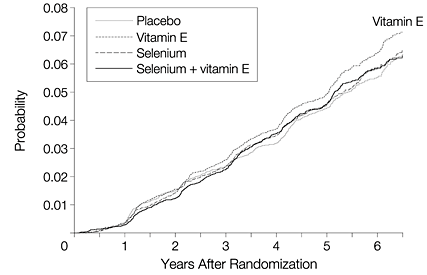
pointed to some worrisome trends: Men taking only vitamin E had a
small increase in prostate cancer. And men taking only selenium had
a small increase in diabetes.
The researchers caution that neither of those
increases in risk were statistically significant. They may just be
coincidental blips that won't hold up to further research.
Still, Dr. Eric Klein, a co-chairman of the
study and a physician at the Cleveland Clinic, called the news about
vitamin E and selenium "disappointing."
Klein also said he believes it "highly
unlikely" that the supplements will ultimately prove to have harmful
effects. The researchers plan to continue to track the men's health
for three more years after they stop taking the supplements.
Prostate cancer is one of the leading causes
of cancer deaths among men in the United States. This year, an
estimated 28,660 men will die from prostate cancer, and more than
186,000 new cases will be diagnosed. |

 -tocopheryl
acetate) and matched selenium placebo, selenium + vitamin E,
or placebo + placebo for a planned follow-up of minimum of 7
years and a maximum of 12 years.
-tocopheryl
acetate) and matched selenium placebo, selenium + vitamin E,
or placebo + placebo for a planned follow-up of minimum of 7
years and a maximum of 12 years.