melanoma.jpg (4937 bytes)

     Malignant Melanoma 

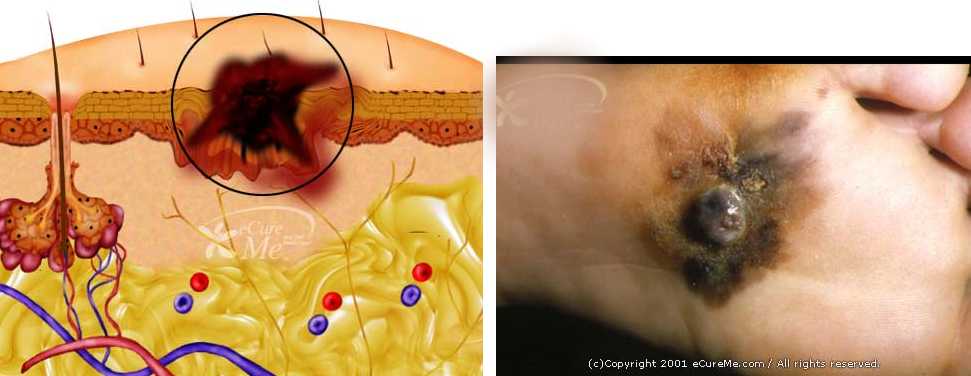
the key to melanoma is early diagnosis or recognizing which moles need to be removed. See the images above, the emphasis is on the abc's of asymmetry, border, color and diameter.

melanoma_interferon.gif (10091 bytes)


Treatment from the NCI


Standard Treatment from the NCI

Stage Definition: (see NCI for more info on stage)
T1:  Tumor 0.75 mm or less in thickness and invades the papillary dermis (Clark's Level II)
T2:  Tumor more than 0.75 mm but not more than 1.5 mm in thickness and/or invades to papillary-reticular dermal interface (Clark's Level III)
T3:  Tumor more than 1.5 mm but not more than 4 mm in thickness and/or Invades the reticular dermis (Clark's Level IV)
T4:  Tumor more than 4 mm in thickness and/or invades the subcutaneous tissue (Clark's Level V) and/or satellite(s) within 2 cm of the primary tumor
Regional lymph nodes (N)
N0:  No regional lymph node metastasis
N1:  Metastasis 3 cm or less in greatest dimension in any regional lymph node(s)
N2:  Metastasis more than 3 cm in greatest dimension in any regional lymph node(s) and/or in-transit metastasis

Stage I (T1 or T2 with N0):

pT1 lesions may be treated conservatively with excision margins of 1 centimeter.   pT2 lesions may require wider surgical excision of the primary tumor. Two randomized trials have demonstrated that for melanomas of  intermediate thickness (>0.75-4.0 millimeters), the surgical margins need to be no greater than 2 centimeters. Both studies showed that when 2 centimeter margins were compared with wider margins (i.e., 4-5 centimeters), there was no statistical difference in local recurrence rates, distant   metastases, or overall survival with a mean follow-up of 6 years. Elective   regional lymph node dissection is of no proven benefit for stage I melanoma.

Stage II (T3N0):

Two randomized trials have demonstrated that for melanomas of intermediate thickness (>0.75-4.0 millimeters), the surgical margins need to be no greater than 2 centimeters.Although prophylactic regional lymph node dissections are often performed for patients with pT3 melanomas, 3 randomized prospective trials have failed to show a benefit in terms of survival for patients undergoing such dissections for extremity melanomas.

Under clinical evaluation:A multicenter, randomized, controlled study has demonstrated that high-dose interferon alfa-2b resulted in a significant prolongation of relapse-free survival and overall survival when compared to no adjuvant therapy.This trial   included 280 patients at high risk for recurrence after curative surgery for melanoma (stages II (T4,N0) and III). The overall median survival for patients receiving interferon is 3.8 years compared with 2.8 years for those in the observation group. A subsequent trial by the same group  indicate a significant relapse-free survival advantage for patients who received high-dose interferon compared to observation, but not for patients who received the lower dose regimen. Neither high- nor low-dose interferon yields a significant overall survival benefit compared to observation. The difference in the survival results between this study and the previous study is currently unexplained. Pooled analyses of the 2 high-dose arms versus the 2 observation arms from both studies suggest that treatment confers a significant relapse-free survival advantage, but not a significant benefit for survival. In selected patients, sentinel lymph node biopsies should be considered. If metastatic melanoma is identified, a formal lymph node dissection can then be performed. Although follow-ups are still short, few patients appear to develop lymph
node metastases when the results of the sentinel node biopsy are negative.

Stage III (T4 or N1 or N2):

1. Wide local excision of the primary tumor with up to 3 centimeter margins of adjacent skin, with skin grafting if necessary to close the resulting defect, and regional lymph node dissection of clinically involved lymph nodes.

2. A multicenter, randomized, controlled trial has demonstrated that high-dose interferon alfa-2b administered at maximum tolerated doses resulted in a significant prolongation of relapse-free survival and overall survival when compared with no adjuvant therapy. Pooled analyses of the 2 high-dose arms versus the 2 observation arms from both studies suggest that treatment confers a significant relapse-free survival advantage, but not a significant benefit for survival. Autologous bone marrow transplantation with high-dose chemotherapy has not been shown to improve survival.

Stage IV (M1)  options:

Melanoma metastatic to distant lymph node-bearing areas may be palliated by regional lymphadenectomy. Isolated metastases to the lung, GI tract, bone, or occasionally the brain may be palliated by resection with occasional long survival. Radiation therapy may provide symptomatic relief for metastases to brain, bones, and viscera.

Advanced melanoma is refractory to most standard systemic therapy, and all newly diagnosed patients should be considered candidates for clinical trials. Although advanced melanoma is relatively resistant to therapy, several biologic response modifiers and cytotoxic agents have been reported to produce objective responses.

The objective response rate to dacarbazine (DTIC) and the nitrosoureas, carmustine (BCNU) and lomustine (CCNU), is approximately 20%.Responses are usually short-lived, ranging from 3 to 6 months, although long-term remissions can occur in a limited number of patients who attain a complete response. Other agents with minimal single-agent activity include vinca alkaloids, platinum compounds, and taxanes. Phase II studies of 3-drug combinations showed higher response rates than were seen with single agents, ranging from 25% to 45%. Randomized trials comparing these combination regimens with DTIC have not consistently demonstrated any advantage for the combination, The addition of tamoxifen to the 3-drug combination regimen of cisplatin, BCNU, and DTIC showed high response rates in phase II studies, with a 20% complete response rate in several trials.A phase III trial testing the 3 drugs with and without tamoxifen showed no benefit for the addition of tamoxifen, and the response rates for both study arms were once again in the 20% to 25% range. Pending results from ongoing trials, no combination regimen has yet been proven superior to DTIC alone.

The 2 biologic therapies that appear most active against melanoma are interferon alfa (IFN-A) and interleukin-2 (IL-2). Response rates for IFN-A range from 8% to 22%, and long-term administration on a daily or a 3 times per week basis appears superior to once per week or more intermittent schedules. Response to IL-2 regimens is similar, in the 10% to 20% range.Phase II studies testing combinations of IFN-A and IL-2 have demonstrated high response rates, but a phase III comparison of IFN-A and IL-2 compared with IL-2 alone in 85 patients did not show any benefit for the combination.

Combinations of chemotherapy and biologics (chemoimmunotherapy or biochemotherapy) have been tested against chemotherapy alone. Pending the results of these and future trials, there is as yet no proof that biochemotherapy is superior to chemotherapy.

setstats 1 1

setstats1 1