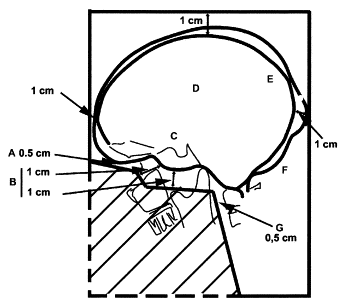
Supratentorial target
The entire brain must be covered with particular attention to the region of the cribriform
plate and the temporal lobe region. The required safety margin below the orbital roof and
the upper part of the orbital block (A) was 5 mm and between the posterior part of the
orbital block and the lowest part of the temporal fossa 1 cm (B).
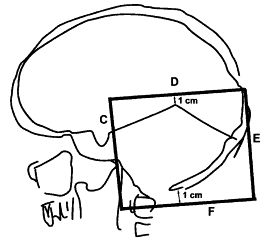
Posterior fossa volume
The anterior margin (C) was 0.5 cm in front of the clivus, the upper margin (D) was 1 cm
above the midpoint between the intersection of the bisector with the superior and inferior
skull . The posterior limit was a parallel line to the anterior margin through the
torcular. The lower margin of the posterior fossa was 1 cm below the occipital foramen.
Spinal axis
Transverse vertebral processes must be included in totality in the field. The inferior
aspect was 1 cm below the dural sac or at the level S2/S3, without a
“spade-like” widening of the field inferiorly. The minimal spinal field width
was 6 cm in case of electron beam therapy and 5 cm in case of photon beam. The dose
prescription was calculated at the anterior aspect of the spinal cord for photon beam and
at the maximum dose point for electron beam. The dose heterogeneity in the vertebral body
must be less than 15%.
|