|
Radiotherapy for primary localized (stage I and II) non-Hodgkin's lymphoma
of the oral cavity. Sunaba K, Int J Radiat Oncol Biol Phys. 2000 Apr 1;47(1):179-83 Department of Radiology, Tokyo Medical and Dental University, Tokyo, Japan. |
||
|
||
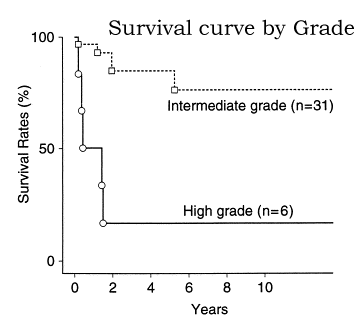
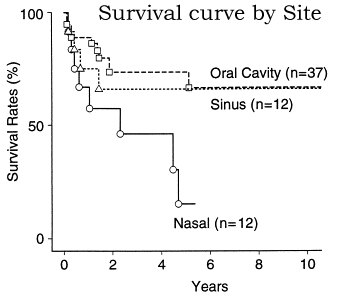
| PURPOSE: To assess the role of radiation therapy in the treatment of primary localized (Stage I: 24 cases and Stage II: 13 cases) non-Hodgkin's Lymphoma (NHL) of the oral cavity. METHODS AND MATERIALS: In total, 37 patients (27 male, 10 female) with primary localized NHL of the oral cavity have been treated with radiotherapy alone (23 cases) or radiation with chemotherapy (14 cases). The age range was 29 to 86 years (median: 65). Clinical and treatment variables with potential prognostic significance for survival were evaluated by univariate and multivariate analysis. Of the 37 patients, 31 (84%) had intermediate-grade lymphomas and six (14%) had high-grade lymphomas. Four patients showed necrotic ulcer in the central portion of the hard palate. RESULTS: The 5-year actuarial survival rate for all cases was 73%. The 5-year survival rates for intermediate-grade and high-grade lymphoma were 85% and 14%, respectively. Significant prognostic factors identified by the multivariate analysis were histologic grade of malignancy (p = 0.02) and central necrotic ulcer in the tumor (p = 0.02). Chemotherapy did not improve survival (p = 0.41). CONCLUSIONS: Our analysis suggests that radiotherapy alone may be approved as the treatment for localized oral NHL with no ulceration and intermediate histology. However, patients with high-grade lymphoma and/or necrotic ulcer are difficult to cure with radiation alone and aggressive treatment should be advocated to improve survival. |
| External
beam radiation therapy in the treatment of patients with extranodal stage
IA non-Hodgkin's lymphoma. Briggs JH, Am J Clin Oncol. 2002 Feb;25(1):34-7 Department of Radiation Oncology, University of Arizona Cancer Center, 1501 North Campbell Avenue, Tucson, AZ 85724, U.S.A. The purpose of this report was to study the results of external beam radiotherapy for patients with extranodal stage IA non-Hodgkin's lymphoma (NHL). A retrospective review was carried out on 27 patients seen between 1984 and 1998 with stage IA NHL of extranodal sites, and followed up for a minimum of 1 year. Sites involved included eye/orbit (seven), parotid (five), breast (four), Waldeyer ring (four), thyroid (three), other head and neck (two), stomach (one), and prostate (one). All patients had biopsy-proven disease and underwent staging workup to rule out other sites of disease. Histologic analysis revealed 16 patients with low-grade NHL, 9 with intermediate-grade, and 2 with high-grade. Ten patients received chemotherapy before radiation therapy, and eight of them had a complete response. The remaining 17 patients were treated with external beam radiation therapy alone. Radiation was directed to the involved field at 1.8 Gy to 2.0 Gy per fraction to a median dose of 40 Gy (range: 20-50.4 Gy). The median patient age was 71 years (range: 39-85 years); 55% were female, and 45% were male. A complete response was attained in all 27 patients after radiation therapy. There were five failures (all in uninvolved distant sites), and two deaths during the follow-up. Median disease free survival (DFS) and overall survival (OS) have not been reached. The 5-year DFS and OS are 85% and 94%, respectively. Older age at presentation showed a trend toward worse outcome (p = 0.07), but because of the relatively few events, other factors (radiation dose, grade of disease, sex, or the use of chemotherapy) showed no statistical differences among the patients. External beam radiation therapy is a highly effective treatment for stage IA NHL found in extranodal sites. |
|
|||
|
|
|||
|
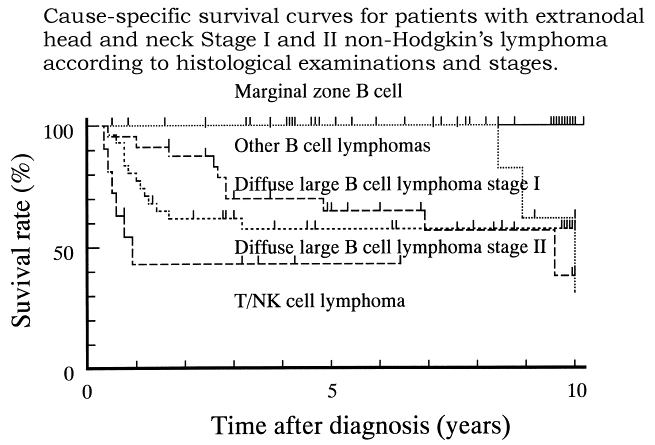
Purpose: We re-evaluated histopathological specimens of head and neck
early-stage extranodal
non-Hodgkin’s lymphoma (NHL)
using the revised European and American
lymphoma (REAL)
classification, and also investigated the relationship between the
clinical characteristics and histopathological classification in an
attempt to evaluate the usefulness of this new classification system in
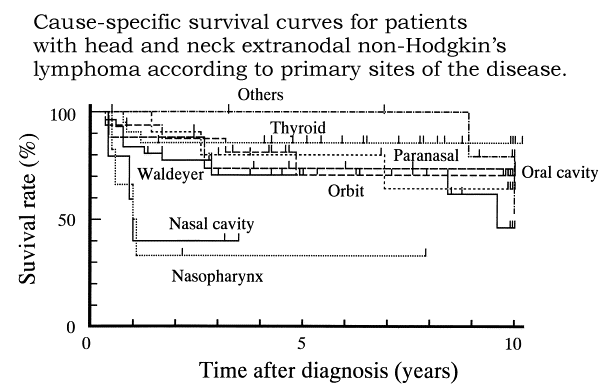
selecting treatment modalities. Materials and Methods: Between 1979 and 1995, 117 patients with histologically confirmed stages I and II NHL of head-and-neck extranodal regions were treated. Of these patients, 110 specimens were available for re-evaluation. Sixty-four patients had Stage I, and 46 had Stage II diseases. All but 3 had received radiation therapy, and 59 patients were also treated with intensive combination chemotherapy. Results: There were 32 extranodal marginal-zone B-cell lymphomas, 57 diffuse large B-cell lymphomas, 11 peripheral T/NK-cell lymphomas, and 10 others. The 5- and 10-year cause-specific survival rates for all patients were 72% and 62%, respectively. Patients with extranodal marginal-zone B-cell lymphoma or other low-grade B-cell lymphomas demonstrated higher survival rates than patients with other lymphomas. Patients with peripheral T/NK lymphomas showed the lowest survival rate. Conclusion: The REAL classification accurately indicated the prognosis of patients with NHL. These results suggest that appropriate treatment modalities can be selected using this classification. |