|
|
|
|
|
|





|
|
literature review of radiation in the treatment of KS |
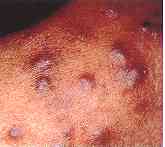
typical purple appearance of Kaposi's Sarcoma skin lesions |
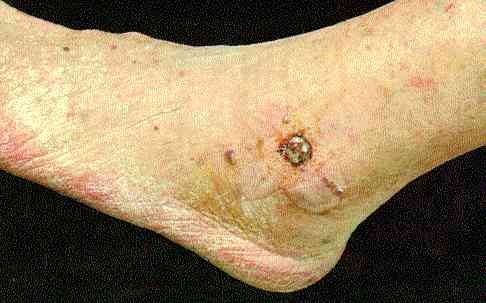
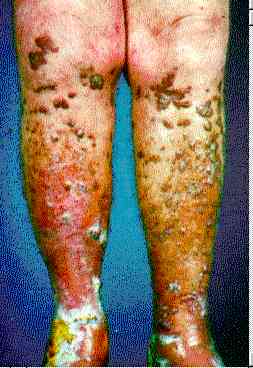
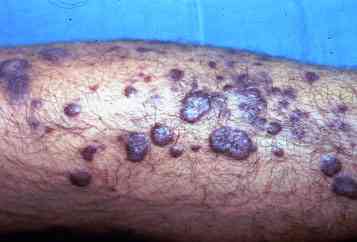
other pictures of KS: back, foot, legs, skin |
|
|
|
|
|
|
|
|
literature review of radiation in the treatment of KS |
typical purple appearance of Kaposi's Sarcoma skin lesions |
other pictures of KS: back, foot, legs, skin |
|
Radiation therapy is the most widely used local therapy for the treatment of KS. Most irradiated lesions regress with treatment, but regrowth, often in 4-6 months, is common. Radiation therapy provides effective palliation of cosmetically disturbing lesions or localized bulky symptomatic disease at any site. Electron beam therapy, which has limited penetration beyond the dermis, is effective for superficial lesions and generally provides good cosmetic results. Initially, raised lesions flatten, lesion size may decrease, and a violaceous lesion generally changes to a tan-brown, hyperpigmented spot. Genital KS associated with pain, difficulty with urination, or psychologic discomfort may be well palliated with electron beam therapy without significant toxicity. Conventional beam irradiation is a good choice for deep or bulky lesions. No standard dosing schedule for radiation can be recommended. Responses have been seen with dosing schedules ranging from single doses of 800 cGy to fractionated schemes with total doses exceeding 4,000 cGy.The optimal radiation schedule and dose are defined by the goals of therapy. A randomized, prospective trial of three radiation doses and schedules (40 Gy in 20 fractions, 20 Gy in fractionated doses, or a single 8 Gy dose) observed a greater time to treatment failure and the least residual cutaneous pigmentation for lesions treated with 40 Gy. Radiation therapy is effective in treating oral cavity lesions, but because of the significant risk of radiation-induced mucositis, this therapy should be reserved for symptomatic disease. To minimize the morbidity of oral cavity irradiation, patients should be aggressively pretreated for local fungal and herpetic infections, and prescribed use of an antibacterial mouthwash. Edema secondary to lymphatic obstruction may be palliated with radiation, but the benefit is often short-lived and may be complicated by brawny induration, fibrosis, or ulceration, particularly in previously irradiated fields. With the exception of patients with very limited survival expectations, radiation therapy for symptomatic visceral KS is not recommended. |
Radiation therapy for AIDS-related Kaposi's Sarcoma.
Int J
Radiat Oncol Biol Phys. 1990
Sep;19(3):569-75.
SourceDepartment of Radiation Oncology, University of California, San Francisco 94143. AbstractBetween March 1982 and October 1987, 375 fields in 187 patients with AIDS-related Kaposi's Sarcoma were treated in the Department of Radiation Oncology at the University of California in San Francisco (UCSF). Field sizes ranging from 2 x 2 cm to total skin received doses of 8 Gy in a single fraction to 15-40 Gy in 5-10 fractions. Seventy-four percent of the patients have died. Response to treatment was achieved in over 90% of treated fields, with a median time to progression of 21 months and an actuarial freedom from relapse at 6 months of 69% (97 patients alive). There was no difference in outcome regardless of the fractionation regimen used. Severe reactions were noted in 17% of treated fields, but this incidence was significantly lower when a single fraction of 8 Gy was used (p less than 0.001). Radiation therapy plays an important palliative role in this devastating disease. This review supports the use of a single 8 Gy fraction for all Kaposi's Sarcoma lesions of the skin. Further data regarding single fraction therapy for lesions of other sites are needed. A randomized prospective trial of radiation therapy for AIDS-associated Kaposi's sarcomaIJROBP 1993;27:1057
|