Metastasis to lymph nodes has long
been identified as a major prognostic factor in early stage cervical cancer. However,
certain histopathologic features of cervical carcinomas have been shown to be independent
risk factors for locoregional failures related to disease retained in lymphatic plexi,
irrespective of lymph node status.
These features include large tumor diameter (LTD), deep stromal invasion (DSI), and
presence of tumor in the capillary lymphatic spaces (CLS). A Gynecologic Oncology Group
(GOG) study of 575 women estimated that such risk factors existed in 25% of all Stage IB
cancers and that these factors increased the risk of recurrence from
2% to 31% at 3 years. Earlier, external irradiation (RT) had been proposed to be of
benefit in reducing recurrences in this group of patients. This prospect led to the
development of the current study, GOG Protocol 92. The hypothesis
to be tested was that postoperative external-beam RT to the standard pelvic field reduces
recurrence and improves the recurrence-free interval in women with Stage IB cervical
cancers with negative lymph nodes and certain poor prognostic features treated by radical
hysterectomy and pelvic lymphadenectomy. External-beam
RT without additional vaginal brachytherapy was to start 4 to 6 weeks after surgery. The
median interval between randomization and beginning of pelvic RT was 14 days.
Pelvic fields consisted of a 4-field technique with beam energies of at least 4
MeV, although 60Co could be used if the source-to-skin distance was 80 cm or greater.
Total dose to be delivered was 46 Gy (in 23 fractions of 2.0 Gy) to 50.4 Gy (in 28
fractions of 1.8 Gy), 5 fractions per week. Treatment interruptions were to be no more
than 1 week. The median duration of RT treatment was 5.7 weeks (range, 0.1–13.3
weeks) (excluding 9 patients who received no RT).
Treatment portals included the obturator, hypogastric, and external iliac
lymphatics. The anteroposterior-posteroanterior (AP-PA) portals extended superiorly to the
upper border of L5, inferiorly to the upper third of the obturator foramen, and laterally
at least 1 cm beyond the margins of the bony pelvis at the widest plane through the
pelvis. The lateral portal boundaries were superior and inferior (the same as the AP-PA
boundaries), anterior (transverse line drawn through the pubic symphysis), and posterior
(at least 4 cm beyond the cervical marker). The minimum anterior–posterior dimension
of the lateral field was 9 cm, including the S2/S3 junction. The results from
retrospective studies have disagreed as to the value of postoperative irradiation in
node-negative Stage IB cervix cancer. As discussed in the previous publication ,
complications were a major concern. Although the difference in Grade 3 or 4 AEs in the
current report was not statistically significant at the traditional 0.05 level (6.6% vs.
2.1%, p = 0.083), it was notable enough to warrant that the clinician will need to weigh
whether the postoperative RT complications presented an acceptable cost-benefit ratio,
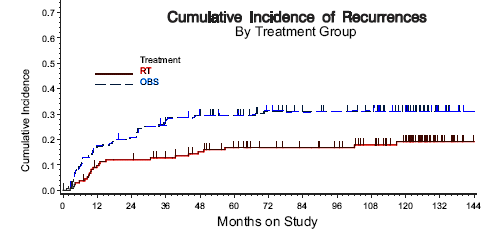
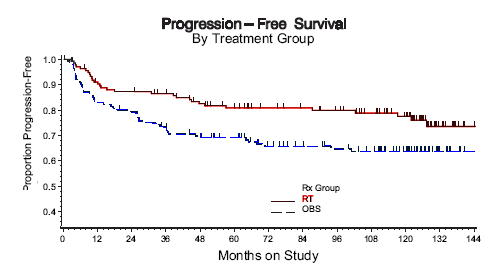
despite the significantly higher recurrence rate (30.7% vs. 17.5%) and progression/death
rate (35.0% vs. 21.9%) in the OBS arm. If a definite survival benefit had also been shown
in this study (HR = 0.70, p = 0.074), the decision to use RT would be much easier.
The disparity between recurrence results and survival results in this study is surprising,
given that survival comparison usually parallels recurrence comparisons in locally
advanced cervix cancer trials. However, the sample size may have been too low. The study
had 80% power to detect only risk reductions of 46% or greater in OS and did not find
significant the 26% to 30% hazard reductions reported above.
Whereas many studies have pointed out the prognostic significance of CLS involvement,
stromal invasion, and tumor size either alone or combined, others have shown them to
have little influence on recurrence rate or survival . A prior
GOG study (of squamous cervical tumors) confirmed the prognostic significance of CLS
involvement, stromal penetration, and tumor size
Two prognostic factors that seem to have become increasingly important in recent years
have been cell type (adenocarcinomatous and adenosquamous tumors), and size (tumors 4 cm
in diameter). In this study, the prevalence of both of these factors was higher in the RT
arm, but these imbalances did not reduce the effectiveness of the RT arm (HR adjusted for
cell type and tumor size = 0.60; 90% CI = 0.41 to 0.89; p = 0.016). Although tumor size
contributes to risk of recurrence and mortality, in this study analysis of the effect of
tumor size is precluded because of the confounding influence of the other eligibility
criteria (small tumors required both of the other high-risk factors to be included,
whereas large tumors required only 1 other factor). Lai et al. (19) reported that after
control for confounding factors, histologic type (adenocarcinomatous and adenosquamous vs.
squamous) was confirmed as an independent prognostic factor for reduced recurrence-free
survival (RR = 1.28; p = 0.009) and OS (RR = 1.26; p = 0.0146) for Stage IB and II
cervical cancer patients after primary radical surgery. When only Stage IB patients were
considered (n = 521), histologic type was no longer a significant factor, although the
relative risks for PFS and OS were 1.36 and 1.53, respectively (Lai, personal
communication). In the current study, only 8.8% (3 of 34) of the patients with
adenocarcinoma or adenosquamous tumors in the RT arm recurred vs. 44.0% (11 of 25) in the
OBS arm. This outcome suggests that RT may be very valuable for such patients.
GI/GU complications
The reported incidence of GI/GU complications from use of
postoperative irradiation has varied in the literature from 3% to 30% . The
reasons for such a disparity are multiple and include differences in the reporting (all
grades or just Grades 3 and 4) of complications. GI toxicity appears to be the most common
and of greater concern, although bladder and ureteral toxicity cannot be ignored. The increase in Grade 3 to 4 complications reported in this study (6.6%
RT and 2.1% OBS) may have been magnified by reporting bias. Lymphedema of the
lower extremity (foot) was not considered in this study, although it has been reported by
others as a significant complication of combined radical hysterectomy, lymphadenectomy,
and irradiation
Landoni reported in the Lancet that, in a study of 337 patients, the incidence of
severe complications for surgery alone was not significantly different from those for
combined surgery plus RT for Stage IB/IIA cervical cancer patients; and both were
significantly more frequent than those seen in patients given RT alone (28% vs. 12%; p =
0.0004).
Conclusions: Pelvic radiotherapy after radical
surgery significantly reduces the risk of recurrence and prolongs progression-free
survival in women with Stage IB cervical cancer. RT appears to be particularly beneficial
for patients with adenocarcinoma or adenosquamous histologies. Circumstances that may have
influenced the overall survival differences are considered. |