| Until now, surgery has been the
mainstay of curative treatment in patients with thoracic
esophageal cancer.
However, after preoperative
chemoradiation, 18% to 25% of the tumors are sterilized.
With chemoradiation
alone, a median survival time of 11 to 22 months was
observed, and the 5-year survival rate reached 27% with
chemoradiation in a randomized study,which is similar to
the rate after surgery. Furthermore, nonrandomized studies
in patients treated with chemoradiation found similar survival
rates with or without additional surgery. The Fédération
Francophone de Cancérologie Digestive (FFCD) was thus
prompted to carry out a randomized trial comparing
chemoradiation alone with chemoradiation followed by
surgery in patients with esophageal cancer. The aim was
to demonstrate the equivalence of the overall survival
after chemoradiation alone or chemoradiation followed by
surgery in patients responding to initial chemoradiation.
Patients and Methods: Eligible patients
had operable T3N0-1M0 thoracic esophageal cancer.
Patients received two cycles
of fluorouracil (FU) and cisplatin (days 1 to 5 and 22 to
26) and either conventional (46 Gy in 4.5 weeks) or
split-course (15 Gy, days 1 to 5 and 22 to 26)
concomitant radiotherapy. Patients with response and no
contraindication to either treatment were randomly assigned
to surgery (arm A) or continuation of chemoradiation (arm B;
three cycles of FU/cisplatin and either conventional [20 Gy]
or split-course [15 Gy] radiotherapy). Chemoradiation
was considered equivalent to surgery if the difference in
2-year survival rate was less than 10%.
Radiotherapy included the macroscopic
tumor and lymph nodes, with a 3-cm proximal and distal
margin and a 2-cm radial margin. The use of three or
four fields and daily treatment of all fields were
required. Initially, the following two techniques were
allowed, according to the initial choice of the investigator
for all of his or her included patients: split-course or
conventional radiotherapy. Split-course radiotherapy was
delivered in daily fractions of 3 Gy, including two
sequences (days 1 to 5 and 22 to 26; 30 Gy) before random
assignment and one sequence (days 43 to 47; 15 Gy) after
random assignment in arm B (total, 45 Gy). Each sequence
was separated by a 2-week rest period. Conventional
radiotherapy was delivered in
5 daily fractions
per week of 2 Gy during the 4.5 weeks before random assignment
(46 Gy) and the 2 weeks after random assignment (20 Gy), for
a total of 66 Gy. Beginning January 1999, an amendment
based on the results of a randomized study permitted only
conventional radiotherapy.
Results: Of 444 eligible patients,
259 were randomly assigned; 230 patients (88.8%) had
epidermoid cancer, and 29 (11.2%) had glandular
carcinoma. Two-year survival
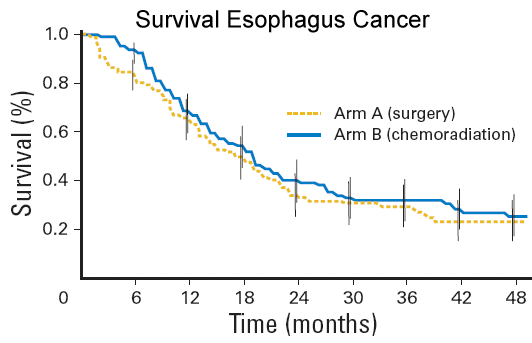
rate was 34% in arm A versus 40% in arm B .
Median survival time was
17.7 months in arm A compared with 19.3 months in arm B.
Two-year local control rate was 66.4% in arm A
compared with 57.0% in arm B, and stents were less
required in the surgery arm (5% in arm A v 32% in arm B; P <
.001). The 3-month mortality rate was 9.3% in arm A compared
with 0.8% in arm B (P = .002). Cumulative hospital stay was
68 days in arm A compared with 52 days in arm B (P = .02).
Conclusion: Our data suggest that, in
patients with locally advanced thoracic esophageal
cancers, especially epidermoid, who respond to chemoradiation,
there is no benefit
for the addition of surgery after chemoradiation compared
with the continuation of additional chemoradiation.
Our results suggest that
chemoradiation alone and chemoradiation followed by
surgery are equivalent in terms of survival and quality
of life in responders. Results were given from the start
of treatment and not from random assignment because, although
the differences were nearly the same, the results from the
start of treatment better reflected overall survival.
Indeed, the treatment administered before random
assignment lasted for more than 1 month.
Our study results are
consistent with the results from the study by Stahl
in which 172 patients with epidermoid esophageal cancer
were randomly assigned to either chemoradiation with
surgery or chemoradiation without surgery. Median
survival time was 16.4 months with surgery compared with
14.9 months without surgery, and 2-year survival rates were
39.9% and 35.4%, respectively. As in our study, freedom
from local progression was longer in the surgery group
versus the no surgery group (at 2 years, 64.3% v 40.7%).
If the patients responding to induction chemotherapy were
considered, 3-year survival rates were 58% and 55% in the
surgery and no surgery groups, respectively.In the FFCD 9102 study,
random assignment was not performed at registration to
test the efficacy and tolerance of chemoradiation and,
hence, avoid cross over or continuation of an inefficient
therapy. A smaller than expected percentage of patients was
randomly assigned (57% instead of 75%). The rates of 71% and
87% for complete clinical response, which we based our
calculations on, were drawn from phase II studies that
included tumors that were not always locally advanced.
Moreover,14 patients refusing surgery and 10 patients not
fit for surgery were not randomly assigned. Thus, 24 more
patients were eligible for chemoradiation (ie, 64%).
A significant difference in
therapeutic mortality was observed, and one could
consider that chemoradiation increased the postoperative
mortality rate, hence undercutting the benefit of surgery. However,
a significantly higher operative mortality rate was reported
only in two randomized studies comparing preoperative
chemoradiation with surgery alone (9% v 4%, respectively,
for Walsh; 12% v 4%, respectively for Bosset ). In the
latter study, the high dose per fraction (3.7 Gy) was
probably responsible. In contrast, Le Prise Urba
and Burmeister observed similar mortality rates in
both the chemoradiation and surgery arms (9% v 7%, 2% v
4%, and 5% v 6%, respectively). Conversely, the benefit
of chemoradiation may have been undercut in the first
period of the trial by split-course chemoradiation, which
was later demonstrated to be inferior to conventional
protraction in a randomized study.
The dose of 66 Gy used in our trial
seems excessive considering the conclusion of the INT
0123 study that a dose of 64.8 Gy is not superior to 50.4
Gy. However, our study design was different and permitted
the delivery of three cycles of concomitant
chemoradiation instead of two cycles, as in the INT 0123 trial.
Regarding adjuvant chemotherapy, although previous studies
were negative, the Medical Research Council OE 02 trial
concluded that two preoperative cycles of FU plus
cisplatin resulted in a better survival than surgery
alone without increasing operative mortality.This raises
the question of which of the following is the optimal
preoperative treatment: chemotherapy or chemoradiation.
Actually, several trials testing preoperative chemoradiation
versus surgery showed a trend favoring chemoradiation,and in a
recent series, preoperative chemoradiation was predictive
of R0 resection, which was a positive prognostic factor.
Meta-analyses
suggest that preoperative chemoradiation improves 3-year survival
and decreases locoregional recurrence rate, although no such
beneficial effects are observed after preoperative
chemotherapy. However, it is difficult to conclude
about the best neoadjuvant treatment because another
meta-analysis demonstrated opposite results concerning
2-year survival. In our study, no specific type of
surgery was proposed, and this could have produced heterogeneity.
However, 94% of the patients had transthoracic esophagectomies,
and 4% had transhiatal operation. Moreover, randomized studies
or meta-analyses have not demonstrated the superiority of one
technique.
In this study, chemoradiation alone
prevented 46% of the patients from having high-grade
dysphagia until death, compared with previously reported
rates of 60% to 67%.Nevertheless, dysphagia was better
improved after surgery (63% mild or absent before death).
In conclusion, this study suggests
that therapeutic strategies with or without surgery
result in similar survival rates for locally advanced
thoracic esophageal cancer patients responding to
chemoradiation. This study applies especially to patients
with epidermoid tumors, who represented almost 90% of the patients,
although no difference with adenocarcinomas was observed in
multivariate analysis. However, chemoradiation alone entailed
fewer early deaths and a shorter hospital stay but more
locoregional relapses. Because clinical prognostic
factors do not help in choosing between both strategies,
further studies comparing surgery and chemoradiation
should search for new predictive factors and evaluate new
tools to detect early responders. Positron emission
tomography scan was reported to discriminate responders
from nonresponders as early as 14 days after starting chemoradiation
and should be re-evaluated in future studies. |