esophagus_chan.gif (10395 bytes)

Is Radiation Plus Chemotherapy as Good as Surgery?

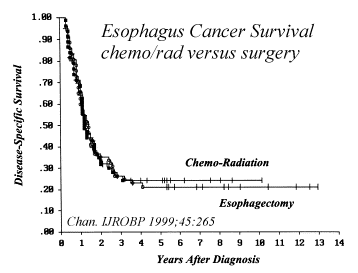
Radiation alone has such a poor cure rate for esophagus cancer that many studies have evaluated combining radiation with chemotherapy which  improves the cure rates. Some studies have compared chemo/radiation with surgery and found the results similar, suggesting that surgery may not be necessary. A recent study (Chan. IJROBP 1999;45:265) compared chemotherapy (Mitomycin/ 5FU/ leukovorin) plus Radiation (50-60Gy) and had survival rates by stage: stage I 55%/5y, stage II 16%/5y and stage III 8%/5y. The overall results with chemoradiation (25%/5y survival) were the same as those patients treated with surgery (23%/5y survival.) Other studies are noted below:

esophagus_bidoli.gif (8949 bytes)

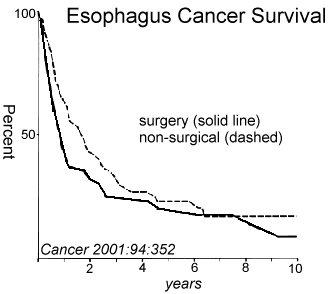
Cisplatin (100 mg/m2 per day) on Day 1 and fluorouracil (1000 mg/m2 per day) on Days 1-4 were given for two cycles, with concomitant RT (30 grays [Gy] in 15 fractions) over 19 days. Patients with potentially resectable tumors were then assessed for curative surgery; the other patients received two more courses of chemotherapy and further RT (20 Gy in 10 fractions).
The median survival for the entire series was 15 months (range, 1-136 months). The overall survival rate was 22% at 5 years and 12% at 10 years. At 10 years, freedom from disease progression was similar in the two groups (24%), whereas the median survival (22 months vs. 12 months) and the overall survival rates (17% vs. 9%) were better in nonsurgical patients compared with surgical patients, respectively,
Bidoli.Cancer 2001:94:352
types of surgical resection

Combined radiation and chemotherapy as primary management of adenocarcinoma of the esophagus and gastroesophageal junction.

Coia Cancer 1988 Feb 15;61(4):643-9

Between January 1981 and December 1986, 20 patients with adenocarcinoma of the esophagus and gastroesophageal junction were entered into a prospective study involving combined radiation therapy and chemotherapy (5-fluorouracil [5-FU] and mitomycin) as primary management. Nine patients with Stage I or II disease received definitive treatment consisting of 6000 cGy in 6 to 7 weeks and 5-FU (1000 mg/m2/24 hours) as a continuous intravenous (IV) infusion for 96 hours starting on days 2 and 29. Mitomycin (10 mg/m2) was administered as a bolus injection on day 2. Ten patients with extraesophageal and disseminated disease (Stages III and IV) and one patient with an unresectable anastomotic recurrence were considered palliative. Generally the palliative regimen did not differ from the definitive except for the radiation dose which in seven of the 11 patients was less than 6000 cGy (4000-5600 cGy). Seven of the eight evaluable definitively treated patients were complete responders. The median relapse-free survival was 10 months and the median survival was 15 months in this group. In the palliative group, six of nine evaluable patients had relief of dysphagia until death or last follow-up with a median duration of 8 months.

Neoadjuvant concurrent chemoradiotherapy followed by definitive high-dose radiotherapy or surgery for operable thoracic esophageal carcinoma.Int J Radiat Oncol Biol Phys 1998 Mar 15;40(5):1049-59

Murakami . forty patients with operable squamous cell carcinoma of the thoracic esophagus were enrolled in a study of neoadjuvant concurrent chemoradiotherapy followed by definitive high-dose radiotherapy (CRT group) or surgery (CRT-S group). Neoadjuvant chemoradiotherapy consisted of 44 Gy in 40 fractions for 4 weeks (2.2 Gy/2 Fr/day) through 10-MVX rays, with 2 courses of cisplatin (80-100 mg/body, mean: 60 mg/m2, Day 1, bolus injection) and 5-fluorouracil (500-1000 mg/body/day, mean: 400 mg/m2, Days 1-4, continuous infusion). Overall survival at 2 and 3 years for CRT vs. CRT-S Group was 72%, 64% vs. 75%, 38%, respectively. No treatment-related mortality was observed. The rate of the 'esophagus conservation' was 65% (Stage 0: 1 of 1, 100%; Stage I: 11 of 12, 92%; Stage II: 8 of 17, 47%; Stage III: 6 of 10, 60%). CONCLUSION: Our results demonstrated that almost all early disease (Stage 0-I) and about half of advanced disease (Stage II-III) could be conserved, their esophagus treated by the multidisciplinary approach centering on high-dose radiotherapy and concurrent chemotherapy.