| Randomized Trial of Preoperative
Chemoradiation Versus Surgery Alone in Patients With Locoregional Esophageal Carcinoma
By
Susan G. Urba , Mark B. Orringer, Andrew Turrisi, Mark
Iannettoni, Arlene Forastiere, Myla Strawderman
From the University of Michigan Medical Center, Ann Arbor, MI. Journal
of Clinical Oncology, Vol 19, Issue 2 (January), 2001: 305-313
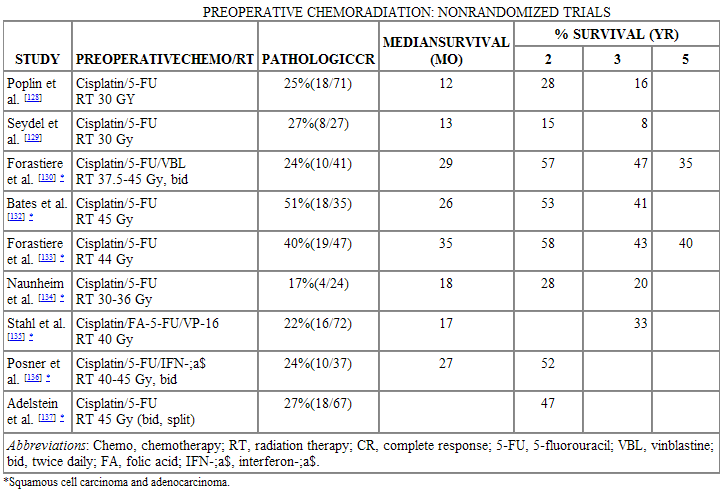
A pilot study of 43 patients with potentially resectable esophageal
carcinoma treated with an intensive regimen of preoperative chemoradiation with
cisplatin, fluorouracil, and vinblastine before surgery showed a median survival of 29 months in comparison with the 12-month
median survival of 100 historical controls treated with surgery alone at
the same institution. We designed a randomized trial to compare survival for
patients treated with this preoperative chemoradiation regimen versus surgery
alone. One hundred patients with esophageal carcinoma were
randomized to receive either surgery alone (arm I)
or preoperative chemoradiation (arm II) with cisplatin 20 mg/m2/d
on days 1 through 5 and 17 through 21, fluorouracil 300 mg/m2/d on
days 1 through 21, and vinblastine 1 mg/m2/d on days 1 through 4 and
17 through 20. Radiotherapy consisted of 1.5-Gy fractions twice daily, Monday
through Friday over 21 days, to a total dose of 45 Gy. Transhiatal
esophagectomy with a cervical esophagogastric anastomosis was performed on
approximately day 42.
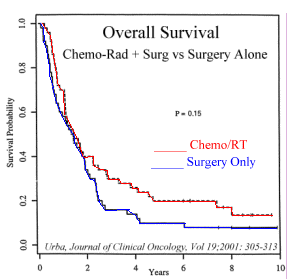
RESULTS: At median follow-up of 8.2 years, there is no significant difference
in survival between the treatment arms. Median survival is
17.6 months in arm I and 16.9 months in arm II. Survival at 3 years was 16% in
arm I and 30% in arm II . This randomized trial of preoperative chemoradiation
versus surgery alone for patients with potentially resectable esophageal
carcinoma did not demonstrate a statistically significant survival
difference.
N Engl J Med 1996 Aug 15;335(7):462-7
A comparison of multimodal therapy and surgery for
esophageal adenocarcinoma.
Walsh. Uncontrolled studies suggest that a combination of chemotherapy and radiotherapy
improves the survival of patients with esophageal adenocarcinoma.
Patients assigned to multimodal therapy received two courses of chemotherapy in weeks 1
and 6 (fluorouracil, 15 mg per kilogram of body weight daily for five days, and cisplatin,
75 mg per square meter of body-surface area on day 7) and a course of radiotherapy (40 Gy,
administered in 15 fractions over a three-week period, beginning concurrently with the
first course of chemotherapy), followed by surgery. The patients assigned to surgery had
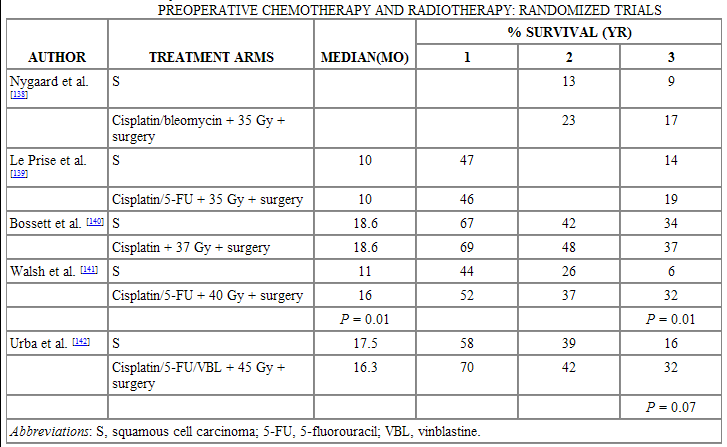
no preoperative therapy. The median survival of patients assigned to
multimodal therapy was 16 months, as compared with 11 months for those assigned to surgery
alone (P=0.01). At one, two, and three years, 52, 37, and 32 percent, respectively,
of patients assigned to multimodal therapy were alive, as compared with 44, 26, and 6
percent of those assigned to surgery, with the survival advantage favoring multimodal
therapy reaching significance at three years (P=0.01).
Cancer 80:1011-20, 1997
Use of Concurrent Chemotherapy, Accelerated Fractionation
Radiation, and Surgery for Patients with Esophageal Carcinoma
Adelstein. Patients
received 2 induction courses with 4-day continuous intravenous infusions of cisplatin (20
mg/m2/day) and 5-fluorouracil (1000 mg/m2/day) beginning on Day 1
and Day 21, concurrent with a split course of accelerated fractionation radiation (1.5
grays [Gy] twice daily, to a total dose of 45 Gy). All patients were subsequently referred
for surgical resection. A single, identical postoperative course of chemotherapy and 24 Gy
accelerated fractionation radiation was planned for patients with residual tumor at
surgery. Seventy-four patients were entered on this study; Sixty-seven patients (93%)
underwent surgery, and 65 (90%) were found to have resectable tumors. Twelve of these
patients (18%) died perioperatively, and 18 (27%) had no residual pathologic evidence of
disease. 4-year projected recurrence free and overall survival rates
were 49% and 44%, respectively.
Int J Radiat Oncol Biol Phys 1995 Jun 15;32(3):753-61
Management of adenocarcinoma of the esophagus with
chemoradiation alone or chemoradiation followed by esophagectomy: results of sequential
nonrandomized phase II studies.
Algan. The incidence of adenocarcinoma of the esophagus is increasing, but the optimal
treatment for this disease is unknown. 11 patients (median age 66) were treated with
concurrent chemotherapy [mitomycin C, and 5-fluorouracil (5-FU)] and radiotherapy to a
median dose of 60 Gy (CRT group). From September 1987 to June 1992, 24 patients (median
age 65) were treated with the same regimen of chemoradiation followed by planned
esophagectomy (CRT+PE group). Of these, 12 patients (median age 62) actually underwent
esophagectomy (CRT+E subgroup). RESULTS: The median overall survival
was 19 months for the CRT group and 15 months for the CRT+PE group. For the CRT+E subgroup, the median overall survival was 33 months.
The 3-year actuarial overall survival for the CRT and the CRT+PE groups were 36 and 28% (p
= 0.949). The subset of patients treated with chemoradiation followed by esophagectomy had
a 3-year actuarial overall survival of 33% (p = 0.274). Treatment-related mortality was 0
out of 11 in the CRT group and 2 out of 24 in the CRT+PE group. Dysphagia relief was
similar in the CRT group vs. the CRT+E subgroup; however, a greater percentage of patients
treated with chemoradiation alone had normal long-term swallowing function when compared
to those patients also undergoing esophagectomy (100% vs. 73%). CONCLUSION: High-dose chemoradiation alone appears to provide similar survival and
relief of dysphagia compared with high-dose chemoradiation followed by esophagectomy for
patients with potentially resectable esophageal adenocarcinoma.
N Engl J Med 1997 Jul 17;337(3):161-7
Chemoradiotherapy followed by surgery compared with
surgery alone in squamous-cell cancer of the esophagus.
Bosset. We conducted a multicenter, randomized trial to
compare preoperative chemoradiotherapy followed by surgery with surgery alone in patients
with stage I and II squamous-cell cancer of the esophagus.
The preoperative combined therapy consisted of two one-week courses; each involved
radiotherapy, in a dose of 18.5 Gy delivered in five fractions of 3.7 Gy each, and 80 mg
of cisplatin per square meter of body-surface area, administered 0 to 2 days before the
first day of radiotherapy. The surgical plan included one-stage en bloc esophagectomy and
proximal gastrectomy by the abdominal and right thoracic routes, to be performed
immediately after randomization in the group assigned to surgery alone and two to four
weeks after the completion of preoperative chemoradiotherapy in the group assigned to
combined therapy. RESULTS: A total of 297 patients entered the study; 11 were found to be
ineligible, and 4 were lost to follow-up. Of the remaining 282, 139 were assigned to
surgery alone and 143 to combined therapy. After a median follow-up of 55.2 months, no significant difference in overall survival was observed; the median
survival was 18.6 months for both groups. As compared with the group treated with
surgery alone, the group treated preoperatively had longer disease-free survival, a longer
interval free of local disease, a lower rate of cancer-related deaths, and a higher
frequency of curative resection. However, there were more postoperative deaths in the
group treated preoperatively with chemoradiotherapy.
Am J Clin Oncol 1997 Feb;20(1):11-5
Integration of surgery in multimodality therapy for
esophageal cancer.
Ebie. While adding chemotherapy to radiation for the treatment of esophageal cancers
has been shown to be beneficial, surgery usually follows treatment or is omitted.
Twenty-five patients with esophageal cancer were treated in a phase I pilot protocol
consisting of initial esophagectomy with gastroesophagostomy and subsequent combined
chemotherapy and radiation. Chemotherapy consisted of cisplatin given on day 1 and
5-fluorouracil (FU) on days 1-5 by continuous infusion. Radiation therapy was administered
in varying fractionation schedules of once or twice daily concomitantly with the
chemotherapy. Treatment was repeated every other week for two to four cycles. Disease-free
survival was 58 and 30% at 1 and 2 years, respectively. Survival was
58 and 32% at 1 and 2 years, respectively (median survival, 19 months). The local control
rate and survival were better than those in our historical experience with cisplatin and
5-FU chemotherapy and radiation given prior to surgery.
Cancer 1998 Nov 1;83(9):1908-16
High dose chemoradiotherapy followed by esophagectomy
for adenocarcinoma of the esophagus and gastroesophageal junction: results of a phase II
study of the Eastern Cooperative Oncology Group.
Keller. Radiotherapy was administered in daily 2-gray (Gy) fractions 5 days a week
until a total of 60 Gy was reached. 5-fluorouracil (5-FU) was infused continuously at a
dose of 1000 mg/m2/day for 96 hours on Days 2-5 and 28-31. On Day 2, a 10 mg/m2 bolus of
mitomycin was injected intravenously. Esophagectomy was performed 4-8 weeks following
completion of the radiotherapy. Overall median survival was 16.6
months, 1-year survival 57%, and 2-year survival 27%. Survival was significantly
worse for patients with circumferential cancers (median, 18.1 months vs. 8.3 months; P
<0.05). CONCLUSION: High dose radiation therapy with concurrent 5-FU and mitomycin may
be administered to patients with esophageal adenocarcinoma with acceptable morbidity.
However, in a cooperative group setting, esophagogastrectomy following intensive
chemoradiotherapy is associated with excessive morbidity and mortality. Circumferential
tumor growth is a significant adverse prognostic factor.
J Thorac Cardiovasc Surg 1997 Aug;114(2):210-7
Preoperative chemotherapy versus surgical therapy alone
for squamous cell carcinoma of the esophagus: a prospective randomized trial.
Law. A prospective randomized trial was undertaken in 147 patients: 74 received
preoperative chemotherapy comprising cisplatin and 5-fluorouracil and 73 had surgical
therapy alone. Median survivals were 16.8 and 13 months,
respectively (p = 0.17). Of those who completed the chemotherapy and resection,
responders fared better than control patients. Median survivals were 42.2 months and 13.8
months, respectively (p = 0.003). Median survival (8.3 months) was worse for nonresponders
than for control patients (p = 0.03). The recurrence pattern suggested a significant
reduction in locoregional disease with chemotherapy. CONCLUSIONS: Preoperative
chemotherapy was safe and resulted in significant downstaging and an increased likelihood
of curative resection. Survival was not better than that in the surgery-alone group, but
responders did fare better than nonresponders. |