| see GOG 0184 here and below for RTOG 9708
Typical Radiation fields and dose as per the RTOG 97-08 / 99-05 trial (high
risk endometrial Risk factors: with one of the following: Grade 2 or 3 with myometrial
invasion >50% , Grade 2 or 3 with stromal invasion of cervix , Known extrauterine
disease (excluding second primary) confined to the pelvis. Positive peritoneal
cytology is acceptable, No known metastases above the iliac bifurcation, no known gross
residual disease, or distant metastases. This protocol used postOp pelvic radiation +
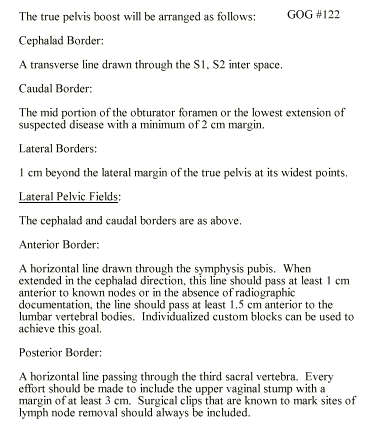
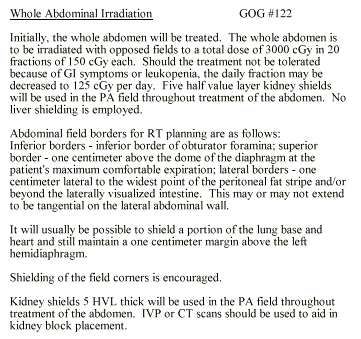
brachy + cisplatin/Taxol.) to see typical GOG technique: pelvis, para-aortic nodes or whole abdomen.
6.0 RADIATION THERAPY (RTOG 8708 and 99-05)
6.1 Radiation therapy is to begin within 8 weeks following surgery.
6.2 Patients will be treated with a combination of external and intracavitary
irradiation.
6.2.1 Pelvic Radiation: The pelvis will be treated to a total dose of
45 Gy in 5 weeks. Patients will be treated once-a-day, 5 days per week with a daily
fraction size of 1.8 Gy. Four-field technique (AP-PA opposed and lateral opposed
fields) must be used if treatment is delivered with a beam energy of < 15MV.
6.2.2 Intracavitary Applications: Cesium may be used with standard
intracavitary systems. For low dose rate applications, 20 Gy to the vaginal surface in a
single application will be given. For high dose rate application, 18 Gy in three
applications will be given.
6.3 External Radiotherapy
6.3.1 Physical Factors: A megavoltage beam of 4 MV or greater, with a
minimum source-axis distance of 100 cm.
6.3.2 Radiation Therapy Fields:
6.3.2.1 Simulation: All fields treated require simulation and portal
verification on the treatment unit. Patients should drink barium 1 hour prior to
simulation to opacify the small bowel. Copies of these films are to be submitted to RTOG
Headquarters.
6.3.2.2 Pelvic Portal (AP-PA)
Superior border A transverse line between L5 and S1.
Lateral border 1-1.5 cm lateral to the widest true pelvic diameter.
Inferior border A transverse line below the obturator foramen and at least 4 cm
beyond the vaginal cuff. A radio-opaque marker in the vagina to mark the vaginal cuff will
help to facilitate proper placement of the lower border.
Custom blocking to shield small bowel and femoral heads should maintain a margin of
at least 1 cm from common iliac nodes and should not shield the obturator foramina.
6.3.2.3 Pelvic Portal (lateral fields)
Superior border Identical to AP-PA fields.
Anterior border A line drawn through the symphysis pubis and at least 1 cm anterior
to common iliac nodes at L5-S1.
Posterior border Care should be taken to include at least S1-S3.
Inferior border Identical to AP-PA fields
Custom blocking should be used to shield anterior small bowel if possible,
maintaining a margin of at least 1 cm from common and external iliac nodes. Blocking MAY
split the L5/S1 vertebral body to shield posterior soft tissue and split the sacrum to
provide adequate margin for pre-sacral nodes. Posterior rectum may be blocked.
6.3.3 External Beam Treatment Techniques and Dose Specifications:
6.3.3.1 When patients are treated with a 4-field technique the contribution to
AP-PA and lateral ports should be calculated by optimizing the dose distribution by
obtaining isodose curves of the pelvis. All fields should be treated daily throughout the
treatment course. AP and PA fields alone may be used if the external beam energy is >15
MV.
6.3.3.2 The specification of target dose is in terms of a dose to a point at or
near the center of the target volume. For the following portal arrangements, the target
dose will be specified as follows:
For 2 opposed coaxial equally weighted beams: On the central ray at mid separation of
beams.
For a 4-field arrangement of beams: At the isocenter of the beams.
The maximum dose in the target volume should not exceed the central dose by more than 5%.
6.3.4 Radiation Treatment Interruption
6.3.4.1 If interruption of two weeks or less occurs, radiation should be completed
to the prescribed total dose.
6.3.4.2 When therapy interruptions of more than two weeks occur, this will be
considered a major deviation from the protocol and resumption of therapy will be at the
discretion of the Radiation Oncologist. Follow-up must continue regardless of radiation
treatment received.
6.4 Intracavitary Radiotherapy Technique and Dose Specifications (Appendix VI)
6.4.1 (9/8/98) The vaginal brachytherapy boost should follow the external beam
irradiation and be started within two weeks of completion of the pelvic irradiation. If
high dose rate applications are to be used, the insertions should be given in such a way
to allow the completion of the three insertions prior to beginning chemotherapy on day 56.
More than one insertion may be performed per week. Iridium OR cesium sources are to
be used for intracavitary application(s) with vaginal applicators for after-
loading applicator system.
6.4.2 It is preferable to treat the vaginal cuff only (treatment of the entire
length of the vagina is discouraged and may increase morbidity). Not more than 2/3 of
the vagina should be included in the treatment volume. Colpostats/ovoids or cylinders may
be used.
6.4.2.1 For low dose rate applications: A dose of 20 Gy prescribed to the
vaginal surface at a dose rate of .8-1.2 Gy per hour. Colpostats or cylinders may be used.
The largest possible cylinder diameter should be selected. Colpostats should be secured
with maximal packing in order to minimize dose to the adjacent bladder and rectum.
6.4.2.2 For high dose rate applications: Three applications of 6 Gy each
prescribed to the vaginal surface. This will give a total of 18 Gy. Dose will be
prescribed at the vaginal surface.
6.4.3 A report on the dose to rectum and bladder and vaginal surface is mandatory.
• Bladder dose may be calculated at a reference point which is obtained as follows: A
Foley catheter is used. The balloon must be filled with 7cm3 of radio-opaque
fluid. On the lateral radiograph, the reference point is obtained on an anterior-posterior
line drawn through the center of the balloon. The reference point is taken on this line at
the posterior surface of the balloon (see Appendix VI). On the frontal radiograph,
the reference point is taken at the center of the balloon.
• Rectal dose may be calculated by either introducing contrast material in the rectum
and marking a point on the rectal wall adjacent to the applicator system or determining
the point 0.5 cm posterior to the vaginal ovoids or vaginal packing in the lateral
projection.
• Vaginal surface dose may be calculated at the vaginal surface lateral to the
midpoint of the surface of the ovoid or cylinder.
6.5 Dose to Critical, Sensitive Structures
Critical sensitive structures are to be considered in the treatment planning. The
following maximal doses for the entire radiotherapy regimen are suggested.
6.5.1 Small bowel: 55 Gy
6.5.2 Bladder: 70 Gy
6.5.3 Rectum: 65 Gy
6.5.4 Vaginal surface: 100 Gy
|