Stage and Cervix Cancer    see new stage system here

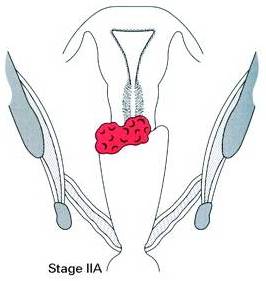
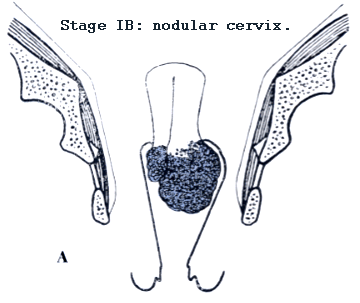
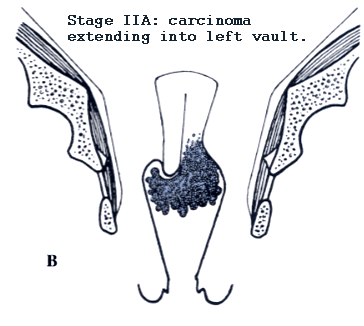
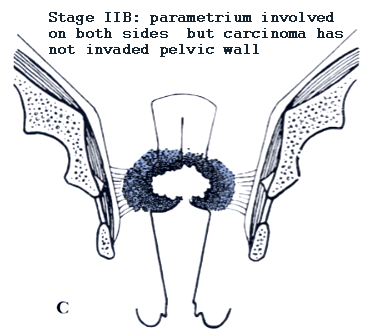
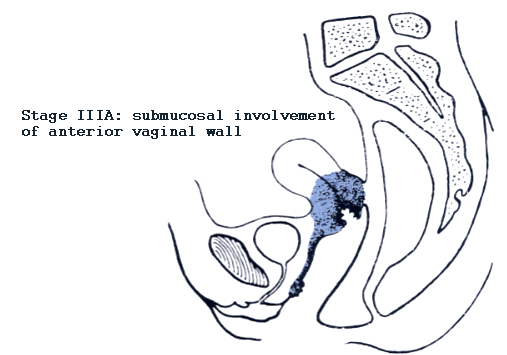
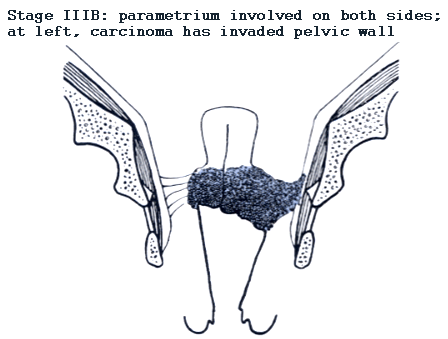
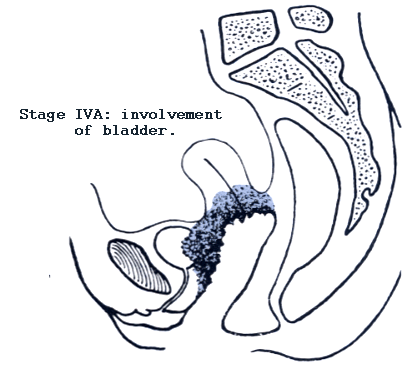
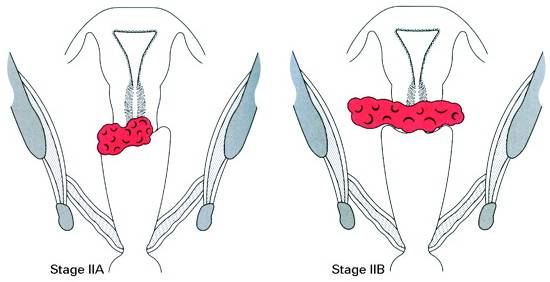
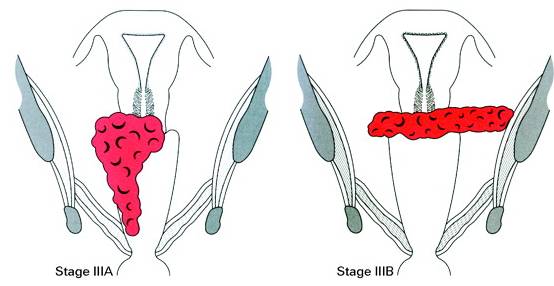
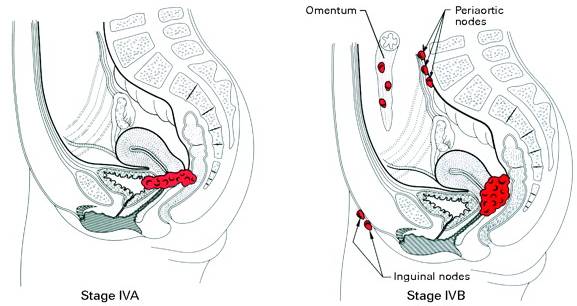
The FIGO stage system and AJCC are discussed below and here, pictures of each stage are noted: stage IB, stage IIa, stage IIb, stage IIIa, stage IIIb, stage IVa, more stage images: stage I, stage II, stage III, stage IV

Stage Distribution: from the NCDB the stage of 17,396 women diagnosed in 2000:

  • Stage 0:  43%
  • Stage I:   24%
  • Stage II:  11%
  • Stage III: 10%
  • Stage IV:   5%
Stage I
Stage I is carcinoma strictly confined to the cervix; extension to the uterine corpus should be disregarded.

Stage IA: Invasive cancer identified only microscopically. All gross lesions even with superficial invasion are stage Ib cancers. Invasion is limited to measured stromal invasion with a maximum depth of 5 mm* and no wider than 7 mm.

Stage IA1: Measured invasion of the stroma no greater than 3 mm in depth and no wider than 7 mm diameter.
Stage IA2: Measured invasion of stroma greater than 3 mm but no greater than 5 mm in depth and no wider than 7 mm in diameter.
Stage IB: Clinical lesions confined to the cervix or preclinical lesions greater than stage IA.
Stage IB1: Clinical lesions no greater than 4 cm in size. Stage IB2: Clinical lesions greater than 4 cm in size.

Stage II
Stage II is carcinoma that extends beyond the cervix but has not extended onto the pelvic wall. The carcinoma involves the vagina, but not as far as the lower third.

Stage IIA: No obvious parametrial involvement. Involvement of up to the upper two-thirds of the vagina.
Stage IIB: Obvious parametrial involvement, but not onto the pelvic sidewall.

Stage III
Stage III is carcinoma that has extended onto the pelvic sidewall. On rectal examination, there is no cancer free space between the tumor and the pelvic sidewall. The tumor involves the lower third of the vagina. All cases with a hydronephrosis or nonfunctioning kidney should be included, unless they are known to be due to other causes.

Stage IIIA: No extension onto the pelvic sidewall but involvement of the lower third of the vagina.
Stage IIIB: Extension onto the pelvic sidewall or hydronephrosis or nonfunctioning kidney.

Stage IV
Stage IV is carcinoma that has extended beyond the true pelvis or has clinically involved the mucosa of the bladder and/or rectum.
Stage IVA: Spread of the tumor onto adjacent pelvic organs.
Stage IVB: Spread to distant organs.

* The depth of invasion should not be more than 5 mm taken from the base of the epithelium, either surface or glandular, from which it originates. Vascular space involvement, either venous or lymphatic, should not alter the staging.
TNM Staging
  • TX: Primary tumor cannot be assessed
  • T0: No evidence of primary tumor
  • Tis: Carcinoma in situ
  • T1/I: Cervical carcinoma confined to uterus (extension to corpus should be disregarded)
    • T1a/IA: Invasive carcinoma diagnosed only by microscopy. All macroscopically visible lesions--even with superficial invasion--are T1b/IB. Stromal invasion with a maximal depth of 5 mm measured from the base of the epithelium and a horizontal spread of 7 mm or less. Vascular space involvement, venous or lymphatic, does not affect classification
    • T1a1/Ia1: Measured stromal invasion 3 mm or less in depth and 7 mm or less in horizontal spread
    • T1a2/IA2: Measured stromal invasion more than 3 mm and not more than 5 mm with a horizontal spread 7 mm or less
    • T1b/IB: Clinically visible lesion confined to the cervix or microscopic lesion greater than T1a2/IA2
    • T1b1/IB1: Clinically visible lesion 4 cm or less in greatest dimension
    • T1b2/IB2: Clinically visible lesion more than 4 cm in greatest dimension
  • T2/II: Cervical carcinoma invades beyond uterus but not to pelvic wall or to the lower third of the vagina
    • T2a/IIa: Tumor without parametrial involvement
    • T2b/IIb: Tumor with parametrial involvement
  • T3/III: Tumor extends to the pelvic wall and/or involves the lower third of the vagina, and/or causes hydronephrosis or nonfunctioning kidney
    • T3a/IIIA: Tumor involves lower third of the vagina, no extension to pelvic wall
    • T3b/IIIB: Tumor extends to pelvic wall and/or causes hydronephrosis or nonfunctioning kidney
  • T4/IVA: Tumor invades mucosa of the bladder or rectum, and/or extends beyond true pelvis (bullous edema is not sufficient to classify a tumor as T4)
    • M1/IVB: Distant metastasis

Regional lymph nodes (N)

  • NX: Regional lymph nodes cannot be assessed
  • N0: No regional lymph node metastasis
  • N1: Regional lymph node metastasis

AJCC stage groupings

Stage 0:  Tis, N0, M0

Stage 0 is carcinoma in situ, intraepithelial carcinoma. There is no stromal invasion.
Stage IA1:  T1a1, N0, M0
Stage IA2:  T1a2, N0, M0
Stage IB1:  T1b1, N0, M0
Stage IB2:  T1b2, N0, M0
Stage IIA:  T2a, N0, M0
Stage IIB:  T2b, N0, M0
Stage IIIA:  T3a, N0, M0
Stage IIIB:  T1, N1, M0 ,  T2, N1, M0,  T3a, N1, M0 ,  T3b, any N, M0
Stage IVA:  T4, any N, M0
Stage IVB:  Any T, any N, M1