Identification of prognostic
factors and risk groups in patients found to have nodal metastasis at the time of radical
hysterectomy for early-stage squamous carcinoma of the cervix.
Alvarez RD, Soong SJ, Kinney WK, Reid GC, Schray MF, Podratz KC, Morley GW, Shingleton
HM.
University of Alabama, Birmingham 35294. Gynecol
Oncol. 1989 Nov;35(2):130-5.
In a retrospective study conducted at the University of Alabama at Birmingham, the
University of Michigan, and the Mayo Clinic, 185 patients with previously untreated FIGO
stage IB and IIA squamous cell carcinoma of the cervix were found to have nodal metastasis
at the time of radical hysterectomy and pelvic lymphadenectomy. Of these patients, 103
received adjuvant pelvic irradiation. Cancer recurred in 76 patients; the median time
to recurrence was 3.1 years. The prognostic significance of patient age, clinical
stage, lesion diameter, number and location of nodal metastases, and use of adjuvant
radiation therapy was determined by multivariate analysis. Only patient age (P = 0.0006),
lesion diameter (P less than 0.0001), and number of nodal metastases (P = 0.0004) were
noted to be significant factors in determining overall survival. Rates of recurrence were
also related to these factors. Employment of these significant variables led to
identification of four risk groups. In general, patients with small cervical lesions
(diameter less than 1 cm) and no more than two nodes with metastases fell into the
low-risk category; those patients with large cervical lesions (diameter greater than 4 cm)
and more than two involved nodes fell into the high-risk category. All other patients
were categorized into intermediate-risk groups.
Ten-year survival was 92% in the
low-risk group (n = 13), 70% in the low-intermediate-risk group (n = 66), 56% in the
high-intermediate-risk group (n = 66), and 13% in the high-risk group (n = 20). This
risk group classification identifies subgroups of early-stage cervical carcinoma patients
found to have nodal metastasis at the time of radical hysterectomy that warrant
appropriately selected adjuvant therapy.Survival
and patterns of recurrence in cervical cancer metastatic to periaortic lymph nodes (a
Gynecologic Oncology Group study).
Berman ML, Keys H, Creasman W, DiSaia P, Bundy B, Blessing J. Gynecol
Oncol. 1984 Sep;19(1):8-16.
Ninety-eight of 621 evaluable patients (16%) with cervical cancer enrolled into
Gynecologic Oncology Group protocols were found to have periaortic lymph node metastases
at staging laparotomy or at exploration for definitive operative management. As expected
there was a progressive increase in the prevalence of periaortic metastases including 5%
of 150 patients with Stage IB, 16% of 222 patients with Stage II, and 25% of 135 patients
with Stage III. Periaortic lymph node metastases in the absence of pelvic lymph node
metastases was an infrequent occurrence in patients so evaluated.
The median survival
of patients with periaortic metastases was 15.2 months with a survival probability of 25%
at 3 years. The median duration of survival following recurrence was only 5 months.
Recurrences were divided approximately equally between the pelvis and distant sites.
Postoperative extended-field irradiation in
patients with pelvic and/or common iliac node metastases from cervical carcinoma stages IB
to IIB.
Inoue T, Chihara T, Morita K. Gynecol Oncol. 1986
Oct;25(2):234-43.
Radical hysterectomy with pelvic and common iliac lymphadenectomy was done for 207 Stage
IB (148), IIA (19), and IIB (40) cervical carcinomas. Pelvic nodal involvement was limited
in 30 (14.5%) cases, whereas common iliac nodes were involved in 16 (7.7%) cases. Common
iliac node metastases were significantly increased, when the number of positive pelvic
nodes increased from 2 to 3 or 4 or more (21.4% to 73.3%, P less than 0.05), when the
tumor invaded deeper than 20 mm (3.7% to 22.2%, P less than 0.001), and when the tumor
extended into parametrial tissues (4.8% to 14.8%, P less than 0.05). Postoperative
extended-field irradiation was administered to 40 patients with nodal metastases.
The
3-year disease-free rates were 85% in 24 patients with positive pelvic nodes, and 51% in
16 patients with common iliac node metastases; 70% in total. These results indicate
that postoperative extended-field irradiation is essential for those patients with nodal
metastases from locally resectable cervical carcinomas.
Lymph node metastasis as a prognostic factor in
cervical carcinoma
Kobierski J, Emerich J, Krolikowska B, Majdak E. Ginekol Pol. 2002
Nov;73(11):925-9.
Kliniki Ginekologii Instytutu Poloznictwa i Chorob Kobiecych Akademii Medycznej w Gdansku.
MATERIAL AND METHODS: 499 patients with cervical carcinoma at stage I and IIa after
radical hysterectomy were included in the study. Diagnosis was based on gynecological
examinations and cervical biopsies. Clinical staging was determined by FIGO
classification. Pelvic lymph nodes were routinely removed on hysterectomy. RESULTS: Metastatic
nodes were observed in 26.3% (131 patients). We found no metastatic nodes at stage Ia.
In the group of 410 patients with stage Ib cervical cancer metastases in lymph nodes were
found in 24.6% (101 patients). In the group of 78 patients with stage IIa cervical cancer
metastatic nodes were observed in 38.5% (30 patients). In our finding metastases were
located in one group of lymph nodes in 64.4% (64 patients) with stage Ib and 43.3% (13
patients) with stage IIa. Metastatic involvement of more than one group of lymph nodes was
observed in 36.6% (37 patients) of stage Ib and 56.7% (17 patients) of stage IIa. The most
frequent pattern of lymph nodes metastatic involvement comprised common iliac and
obturatorious nodes. 5 year survival in the group without metastases in lymph nodes was
estimated at 82.2%, and in the group with nodal metastases 50.8%
(p = 0.005).
CONCLUSIONS: 1. Metastases to pelvic lymph nodes are significant prognostic factor of
long-term survival in patients with cervical cancer. 2. Patients with metastases in lymph
nodes and no subsequent postoperative radiotherapy had significantly worse long-term
survival.
5-year survival of patients with periaortic
nodal metastases in clinical stage IB and IIA cervical carcinoma.
Lovecchio JL, Averette HE, Donato D, Bell J. Gynecol Oncol. 1989
Jul;34(1):43-5.
Department of Obstetrics and Gynecology, University of Miami School of Medicine, Florida
33101.
From 1969 to 1981 thirty-six patients with stage IB and IIA cervical carcinoma were
identified at pretherapy surgical staging laparotomy with histologically documented
metastatic disease to the periaortic lymph nodes. All patients underwent a periaortic node
dissection and all patients completed a course of extended-field radiotherapy in a
postoperative setting. No major radio-therapeutic complications were encountered. The
5-year
actuarial survival rate was 50%, with a median survival time of 29 months. The
median time to recurrence was 10 months, while the median duration of survival
following a recurrence was 7 months. Seventy-five percent of all recurrences occurred at
distant sites. These data demonstrate that survival may be favorably influenced by
employing extended-field radiotherapy in those patients with early-clinical-stage cervical
cancer and periaortic nodal metastases. The subsequent development of distant metastases
after such a treatment regimen emphasizes the need for adjuvant cytotoxic chemotherapy to
enhance overall survival.
Stage IB carcinoma of the cervix, the Norwegian
Radium hospital. II. Results when pelvic nodes are involved.
Martimbeau PW, Kjorstad KE, Iversen T. Obstet Gynecol. 1982
Aug;60(2):215-8.
From 1967 through 1972, 562 patients with squamous cell carcinoma of the cervix, stage IB
(FIGO), underwent radical hysterectomy with pelvic lymphadenectomy. The patients with
pelvic metastases were treated with external beam supervoltage irradiation of 4000 or 5000
rads to the pelvis. Metastases in the pelvic lymph nodes were found in 21.3%. In
this study the authors analyzed in detail which nodes were involved with metastases and
the relationship with survival and with recurrence.
The overall 5-year survival for
patients with pelvic lymph node metastases was 53%; for patients without metastases it was
92%. The site of recurrence in patients without demonstrable pelvic lymph node
metastases was also examined. The main conclusion drawn from the study is that patients
with pelvic node metastases below the common iliac group have a much better prognosis than
patients in whom metastases are located in the common iliac nodes; in addition, when nodal
involvement is below the common iliac level, patients with disease limited to one node or
one group of nodes do not have a better prognosis than patients with multiple metastatic
nodes.
Treatment of FIGO stage Ib cervical carcinoma with nodal involvement.
Pedulla F, Centurioni MG, Foglia G, Ferrari I, Orsatti M, Vitale V, Ragni N.
Istituto di Ginecologia e Ostetricia dell'Universita di Genova. Eur J Gynaecol
Oncol. 1994;15(1):59-64.
One hundred and eighty one patients with stage Ib cervical cancer underwent hysterectomy
with pelvic lymphadenectomy. The overall incidence of lymph node metastases was 20%.
Twenty seven (71%) patients with nodal involvement were treated by external radiotherapy
(TCT) and 11 (29%) by both chemotherapy and radiotherapy (Lin. Acc.). The overall
survival at 5 years was 80%; it was 43% for patients with positive nodes and 89% for
patients without metastatic nodal disease. The 3 year survival of patients with
positive nodes who underwent radiation therapy by TCT was 58%, while it was 72% for those
treated by chemotherapy plus radiotherapy. We observed a recurrence in 23% of the cases,
52% in patients with positive nodes and 15% in those with negative nodes. The association
chemo-radiotherapy in patients with metastatic lymph nodes seems to improve the survival
and reduce the recurrence rate.
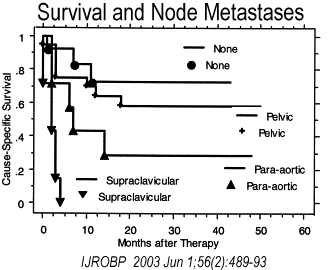
FDG-PET lymph node staging and survival of
patients with FIGO stage IIIb cervical carcinoma.
Singh AK, Grigsby PW, Dehdashti F, Herzog TJ, Siegel BA.
Department of Radiation Oncology, Mallinckrodt Institute of Radiology, Washington
University School of Medicine, St. Louis, MO 63110, USA. Int J Radiat
Oncol Biol Phys. 2003 Jun 1;56(2):489-93.
PURPOSE: To evaluate the outcome of patients with International Federation of Gynecology
and Obstetrics (FIGO) clinical Stage IIIb cervical carcinoma as a function of site of
initial regional lymph node metastasis as detected by 2[18F]fluoro-2-deoxy-D-glucose
(FDG)-positron emission tomography (PET). METHODS AND MATERIALS: Forty-seven patients with
FIGO Stage IIIb cervical cancer were evaluated before therapy with whole-body FDG-PET.
Most patients were treated with external beam irradiation, intracavitary brachytherapy,
and weekly cisplatin for six cycles. Overall and cause-specific survival rates were
calculated by the Kaplan-Meier method. RESULTS: The pretreatment whole-body FDG-PET
demonstrated that all patients had FDG uptake in the cervix. Of 47 patients, 13 (28%) had
no evidence of lymph node metastasis, 20 (43%) had metastasis to pelvic lymph nodes only,
7 (15%) had pelvic and para-aortic lymph node metastases, and 7 (15%) had metastases to
pelvic, para-aortic, and supraclavicular lymph nodes.
The 3-year estimate of
cause-specific survival was 73% for those with no lymph node metastasis, 58% for those
with only pelvic lymph node metastasis, 29% for those with pelvic and para-aortic lymph
node metastases, and 0% for those with pelvic, para-aortic, and supraclavicular lymph node
metastasis (p = 0.0005). CONCLUSION: The cause-specific survival for patients with
FIGO Stage IIIb carcinoma is highly dependent on the extent of lymph node metastasis as
demonstrated by whole-body FDG-PET
xtended field irradiation for carcinoma of the
uterine cervix with positive periaortic nodes.
Vigliotti AP, Wen BC, Hussey DH, Doornbos JF, Staples JJ, Jani SK, Turner DA, Anderson
B.
Dept. of Radiology, University of Iowa College of Medicine, Iowa City.
Int J Radiat Oncol Biol Phys. 1992;23(3):501-9.
Forty-three patients were treated with extended field irradiation for periaortic
metastasis from carcinoma of the uterine cervix (FIGO stages IB-IV). Twelve patients (28%)
remained continuously free of disease to the time of analysis or death from intercurrent
disease, 20 (46%) had persistent cancer within the pelvis, 11 (26%) had persistent
periaortic disease, and 23 (53%) developed distant metastasis. The actuarial 5-year
survival rate was 32%. The results correlated well with the periaortic tumor burden at the
time of irradiation. None of 19 patients (0%) with microscopic or small (less than 2 cm)
periaortic disease had periaortic failures, compared to 29% (4/14) of those with
moderate-sized (2-5 cm) disease and 70% (7/10) of those with massive (greater than 5 cm)
periaortic metastasis. Similarly, the
5-year survival rates were 50% (6/12) with
microscopic disease, 33% (2/6) with small gross disease, 23% (3/13) with moderate-sized
disease, and 0% (0/10) with massive periaortic metastases. Only 10% (1/10) of patients
whose tumor extended to the L1-2 level survived 5 years, compared with 31% (9/29) of those
whose disease extended no higher than the L3-4 level. The periaortic failure rates
correlated to some extent with the dose delivered through extended fields, although the
difference was not statistically significant. Only 8% (1/13) of those who had undergone
extraperitoneal lymphadenectomies developed small bowel complications, compared with 25%
(7/29) of those who had had transperitoneal lymphadenectomies. The incidence of small
bowel obstruction was 8% (1/13) following periaortic doses of 4000-4500 cGy, 10% (1/10)
after 5000 cGy, and 32% (6/19) after approximately 5500 cGy. From this, we concluded that
the subset of patients who would benefit most from extended field irradiation are those in
whom the residual disease in the periaortic area measures less than 2 cm in size at the
time of treatment, whose disease extends no higher than L3, and whose cancer within the
pelvis has a reasonable chance of control with standard radiation therapy techniques. |