|
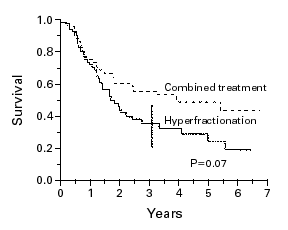
Overall Survival Improvement with Combined Modality Treatment compared to HF radiation alone |
Hyperfractionated Irradiation with or without Concurrent Chemotherapy for Locally Advanced Head and Neck CancerPatients with advanced head and neck cancer who were treated only with hyperfractionated irradiation received 125 cGy twice daily, for a total of 7500 cGy. Patients in the combined-treatment group received 125 cGy twice daily, for a total of 7000 cGy, and five days of treatment with 12 mg of cisplatin per square meter of body-surface area per day and 600 mg of fluorouracil per square meter per day during weeks 1 and 6 of irradiation. Two cycles of cisplatin and fluorouracil were given to most patients after the completion of radiotherapy. At three years the rate of overall survival was 55 percent in the combined-therapy group and 34 percent in the hyperfractionation group (P=0.07). The relapse-free survival rate was higher in the combined-treatment group (61 percent vs. 41 percent, P=0.08). The rate of locoregional control of disease at three years was 70 percent in the combined-treatment group and 44 percent in the hyperfractionation group (P=0.01). Confluent mucositis developed in 77 percent and 75 percent of the two groups, respectively. Severe complications occurred in three patients in the hyperfractionation group and five patients in the combined-treatment group. (Brizel. N Engl J Med 1998;338:1798-804.) |
Accelerated Hyperfractionated Irradiation
The primary tumor and draining lymphatic system were treated isocentrically with 4-MV or 6-MV photons and parallel opposed lateral portals with a source-to-isocenter distance of 80 to 100 cm. Supraclavicular nodes and nodes in the lower part of the neck were treated with the use of a single anterior field, with midline blocking to prevent spinal cord overlap. The spinal cord was blocked in the inferior aspect of both lateral fields for laryngeal primary tumors. The inferior border of the lateral fields and the superior border of the supraclavicular fields coincided on the skin.
Lateral-field doses were prescribed at midplane, whereas a depth of 3 cm was used for the supraclavicular field. Initial fields received a total of 4000 cGy, given in dosages of 125 cGy twice a day with a six-hour interval between doses. The use of the supraclavicular field was discontinued after 4000 cGy had been administered if there were no palpable lymph nodes in the lower part of the neck. In order to shield the spinal cord, the size of the lateral fields was reduced after 4000 cGy had been administered. Electron-beam irradiation was used to boost the dose to the posterior cervical lymph-node chains. The size of the field was again reduced after 5500 to 6000 cGy had been administered. The total dose delivered to the primary tumor was 7500 cGy in a six-week period. Treatment was delivered continuously without any planned interruptions.
Accelerated Hyperfractionated Irradiation and Concurrent Chemotherapy
The dosage and techniques of irradiation were the same as in the group that received accelerated hyperfractionated irradiation alone. A seven-day interruption of radiotherapy was planned after 4000 cGy had been administered, since our phase 1-2 trial had shown that this was necessary to manage treatment-induced mucositis. The total dose intended for the primary tumor was 7000 cGy in a seven-week period.
Chemotherapy
Chemotherapy was administered during weeks 1 and 6 of the course of treatment. Patients received prophylactic hydration and antiemetics. Chemotherapy consisted of fluorouracil and cisplatin (Platinol, Bristol-Myers Squibb, Princeton, N.J.). Fluorouracil was administered as a continuous infusion at a dose of 600 mg per square meter of body-surface area per day for five days. Cisplatin was given as a daily bolus of 12 mg per square meter per day for five days, for a total dose of 60 mg per square meter. Two additional cycles of cisplatin and fluorouracil were planned after the completion of all local therapy, with the cisplatin again divided into five daily boluses, and the dose increased to 80 mg per square meter in cycle 3 and to 100 mg per square meter in cycle 4. There were no provisions for reductions in the doses of chemotherapy.