| Efficacy of MRI and Mammography for
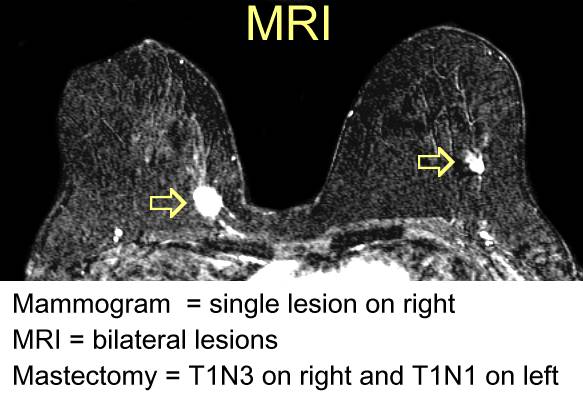
Breast-Cancer Screening in Women with a Familial or Genetic Predisposition Mieke Kriege, M.Sc., for the Magnetic Resonance Imaging Screening Study Group . NEJM 2004; 351:427 Background The value of regular surveillance for breast cancer in women with a genetic or familial predisposition to breast cancer is currently unproven. We compared the efficacy of magnetic resonance imaging (MRI) with that of mammography for screening in this group of high-risk women. Methods Women who had a cumulative lifetime risk of breast cancer of 15 percent or more were screened every six months with a clinical breast examination and once a year by mammography and MRI, with independent readings. The characteristics of the cancers that were detected were compared with the characteristics of those in two different age-matched control groups. Results We screened 1909 eligible women, including 358 carriers of germ-line mutations. Within a median follow-up period of 2.9 years, 51 tumors (44 invasive cancers, 6 ductal carcinomas in situ, and 1 lymphoma) and 1 lobular carcinoma in situ were detected. The sensitivity of clinical breast examination, mammography, and MRI for detecting invasive breast cancer was 17.9 percent, 33.3 percent, and 79.5 percent, respectively, and the specificity was 98.1 percent, 95.0 percent, and 89.8 percent, respectively. The overall discriminating capacity of MRI was significantly better than that of mammography (P<0.05). The proportion of invasive tumors that were 10 mm or less in diameter was significantly greater in our surveillance group (43.2 percent) than in either control group (14.0 percent [P<0.001] and 12.5 percent [P=0.04], respectively). The combined incidence of positive axillary nodes and micrometastases in invasive cancers in our study was 21.4 percent, as compared with 52.4 percent (P<0.001) and 56.4 percent (P=0.001) in the two control groups. In our sensitivity and specificity calculations, we defined lesions that were in BI-RADS category 3 and higher as positive, but most other authors have included in their calculations only lesions in BI-RADS categories 4 and 5 as positive.If we had followed that policy, the sensitivity would have been 24.4 percent for mammography and 46.6 percent for MRI, in accord with the higher sensitivity previously reported for MRI. When we included only invasive breast cancers, the difference between the sensitivity of the MRI and mammography (79.5 percent vs. 33.3 percent) was even greater than the difference overall (71.1 percent vs. 40.0 percent). MRI detected 20 cancers (including 1 ductal carcinoma in situ) that were not found by mammography or clinical breast examination. The stage of these 20 cancers was favorable; 11 of the 19 invasive tumors were smaller than 10 mm, and only 1 was associated with a positive node.Another important matter that we addressed was the best method for detecting carcinoma in situ. Our study showed that mammography had a higher sensitivity than MRI for detecting ductal carcinoma in situ: 83 percent (five out of six cancers detected), as compared with 17 percent (one out of six) for MRI (P=0.22). Conclusions MRI appears to be more sensitive than mammography in detecting tumors in women with an inherited susceptibility to breast cancer. Magnetic Resonance Imaging and Mammography in Women With a Hereditary Risk of Breast Cancer Mark J. Stoutjesdijk,, University Medical Center St Radboud, Nijmegen, The Netherlands. Journal of the National Cancer Institute, Vol. 93, No. 14, 1095-1102, July 18, 2001 Background: Although breast cancer screening is recommended to start at a younger age for women with a hereditary risk of breast cancer, the sensitivity of mammography for these women is reduced. We compared magnetic resonance imaging (MRI) with mammography to determine which is more sensitive and whether MRI could play a role in the early detection of breast cancer for these women. Methods: We constructed a retrospective cohort of all breast MRI and mammography surveillance reports made in our department from November 1994 to February 2001. All of the 179 women in the cohort had received biannual palpation in addition to annual imaging by MRI, mammography, or both. The 258 MRI images and the 262 mammograms were classified with the use of the BI-RADSTM (i.e., Breast Imaging Reporting and Data System) scoring system, which has five categories to indicate the level of suspicion of a lesion. Receiver operator characteristic curves were generated for MRI and mammography, and the area under each curve (AUC) was assessed for the entire cohort of 179 women and for a subset of 75 women who had received both an MRI and a mammographic examination within a 4-month period. All statistical tests were two-sided. Results: In the cohort of 179 women, we detected 13 breast cancers. Seven cancers were not revealed by mammography, but all were detected by MRI. For the entire cohort, the AUC for mammography was 0.74 (95% confidence interval [CI] = 0.68 to 0.79), and the AUC for MRI was 0.99 (95% CI = 0.98 to 1.0). For the subset of women who had both examinations, the AUC for mammography was 0.70 (95% CI = 0.60 to 0.80), and the AUC for MRI was 0.98 (95% CI = 0.95 to 1.0). Conclusion: MRI was more accurate than mammography in annual breast cancer surveillance of women with a hereditary risk of breast cancer. Larger prospective studies to examine the role of MRI in screening programs are justified. |