|
|
Concurrent cisplatin, 5-fluorouracil, leucovorin, and radiotherapy for invasive bladder cancer
|
|
|
Concurrent cisplatin, 5-fluorouracil, leucovorin, and radiotherapy for invasive bladder cancer
|
|
To investigate the tolerance and efficacy of a modified concurrent chemoradiation (CCRT) protocol for patients with invasive bladder cancer ''unfit'' for radical cystectomy. Twenty-three muscle-invasive bladder cancer patients who were unfit for or unwilling to receive radical cystectomy were enrolled in this study. All patients had transitional cell carcinoma of bladder, and distribution of stage was 14 (61%), 1 (4%), and 8 (35%) for T3a, T3b, and T4, respectively. This study included a relatively old-age population, with the median age being 75 and 70% of patients over 70 years old. Patients were treated with maximal transurethral resection of the bladder tumor followed by curative CCRTThe chemotherapy (C/T) regimen was comprised of cisplatin, 50 mg/m2 intravenously (i.v.) on Day 1; 5-fluorouracil (5-FU), 500 mg/m2/day by continuous i.v. infusion on Days 1–3; and leucovorin, 50 mg/day by continuous i.v. infusion on Days 1–3. Chemotherapy course was repeated at 21-day intervals. The radiation dose was 44–45 Gy to whole pelvis and 60–61.2 Gy to bladder, with a daily fraction of 1.8–2 Gy. The completeness of the CCRT protocol was defined as patients receiving at least 55 Gy of radiotherapy to the whole bladder and at least three courses C/T. |
|
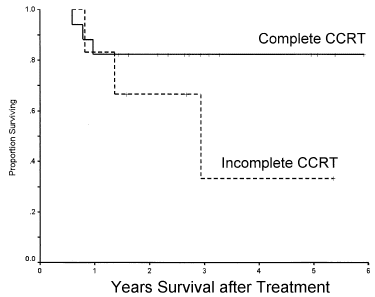
Seventy-four percent of patients (17/23) completed the CCRT protocol. Radiation Therapy Oncology Group (RTOG) Grade 3 acute toxicities were observed in 4 patients, which included leucopenia, vomiting, genitourinary (GU) tract infection, and diarrhea. No treatment-related deaths occurred during the CCRT period. RTOG Grade 3 or more late complications were observed in 3 patients; one of them died of radiation cystitis superimposed with GU infection. Of the 18 patients whose response to CCRT was evaluated, a complete tumor response was documented in 16 patients (89%). With a median follow-up of 3 years, the 3-year overall survival (OS) and disease-free survival (DFS) for all patients was 69% and 65% respectively. Meanwhile, the 3-year overall and DFS rates for patients who completed CCRT vs. those who did not complete CCRT were 82% vs. 33% and 75% vs. 33%, respectively (p = 0.18 for OS and p = 0.04 for DFS). Concurrent cisplatin, 5-FU, leucovorin, and radiotherapy for treatment of invasive bladder cancer is a feasible and promising treatment even for relatively old patients. Our results are comparable to those in recent studies by using combined modality treatment or neoadjuvant chemotherapy plus radical cystectomy. Consequently, this novel protocol warrants a prospective clinical trial and may be a safe, effective alternative to radical cystectomy. Discussion: Radical cystectomy is the major treatment modality for muscle-invasive bladder cancer in many countries, including the United States and Taiwan. In clinical practice, a significant number of patients are deemed unsuited for surgery due to unresectable disease, advanced age, or comorbid conditions. Definitive external beam radiotherapy (EBRT) was traditionally the favored therapeutic alternative in such situations, but the results of EBRT alone are usually poor, with a local recurrence rate of up to 70% and a 5-year survival rate of less than 40% . Recently, many clinical trials employing CCRT with or without neoadjuvant C/T for muscle-invasive bladder cancer showed 5-year survival rates comparable to cystectomy-based studies. However, some of these studies were marred by unsatisfactory patient compliance and high toxicity This work attempted to develop a feasible and tolerable CCRT protocol for older patients, by initiating a Phase II trial for the combination of TUR-BT, RT, and low-dose C/T of cisplatin and 5-FU. Leucovorin was added to enhance 5-FU effects and avoid the therapeutic effects being compromised by low-dose C/T. Our initial results are encouraging. In terms of compliance and toxicity, the completeness of CCRT is 74% for all patients (17/23) and 85% for those older than 75. Severe acute toxicity (Grade 3 or more) was only observed in 4 patients (17%), and no treatment-related deaths occurred during CCRT. Late complications requiring hospital admission were observed in 3 patients. Finally, all of the 15 surviving and disease-free patients had functioning bladders. Compared with a recent Southwest Oncology Group (SWOG) study which also included patients with unresectable tumors, or who were medically unfit for or unwilling to receive surgery, our investigation has a higher compliance rate and less toxicity despite the patients being older than those in the SWOG study (median age: 75 vs. 67). In the SWOG study, patients underwent cystoscopy, and were treated with 75 mg/m2 cisplatin on Day 1 and 1000 mg/m2 5-FU on Days 1 to 4, plus definite radiation. C/T was repeated every 28 days, twice during and twice after radiation. The patient compliance rate was 57% (32/56), and for those patients in whom toxicity could be evaluated, acute Grade III and IV toxicities were 45% (25/55) and 9% (5/55), respectively. Given the similarity of the radiation dose and scheme used in this study and the SWOG trial, one reason for the better patient compliance in this study may be the lower doses of cisplatin and 5-FU used, even though leucovorin was added to enhance the effectiveness of 5-FU. Despite the lower C/T intensities used in this study, the tumor control and survival rates of this study were not inferior to other CCRT studies. In 18 patients evaluated by cystoscope in this study, 89% achieved a complete response (CR). Even using the most conservative estimate, namely categorizing patients who did not receive cystoscopic examination as not achieving CR, the CR rate was still 69%. Meanwhile, the 3-year overall and DFS rates for patients who completed the CCRT protocol were as high as 82% and 75%, respectively. In contrast, the CCRT trial in the SWOG study only achieved an overall response rate of 49% and a 5-year survival rate of 32%. However, the patients in the SWOG study were not routinely treated by TUR-BT, and 22% had documented pelvic lymph nodes metastasis, higher than the 5% with pelvic node metastasis in this investigation. On the other hand, the percentage of Stage T4 patients in the SWOG study was 20%, compared with 35% in this study. In another pilot study conducted by Zouhair total radiation of 60 Gy and 6 mg/m2 cisplatin daily (equal to 180 mg/m2 during the radiation) were delivered to patients with bladder carcinoma or who were medically unsuitable for partial or radical cystectomy. Among 25 patients who were administered the above protocol, chemotherapy was successfully delivered to 18 (72%). In Zouhair's study, although a CR was achieved in 75% (15/20) of evaluable patients, the 4-year overall and disease-specific survival rates of all 25 patients were only 23% and 35%. A total of 52% of patients succumbed to distant metastasis with or without local recurrence, probably because of a lack of any further adjuvant chemotherapy or the ineffectiveness of the chemotherapy regimen in controlling occult metastasis. This phenomenon explained why a CR was achieved in 75% of patients, whereas the 4-year disease-specific survival rate was only 35%. In this study, only 8% of patients had distant metastasis. The novel regimen was not only the most tolerable for this group of patients, but also appeared most effective in achieving a complete tumor response and controlling occult distant metastasis. However, there are obvious limitations and difficulties in comparing this and other studies because case selection criteria might be different among studies. Pelvic lymphoadenopathy, although it is not a criterion for excluding patients from this study, is relatively lower in our patients and the possibility cannot be ruled out that our patients are inherently more favorable in risk factors than other studies. This study did not include neoadjuvant C/T in the treatment protocol, but achieved results comparable to studies that do include neoadjuvant C/T and CCRT. The RTOG 8802 trial included 91 patients with T2–T4aM0 disease and who were suitable for radical cystectomy The patients were given two courses of neoadjuvant C/T with MCV (methotrexate, cisplatin, and vinblastine) followed by 39.6 Gy pelvic RT and concurrent cisplatin. After detailed urologic evaluation, patients with a complete response were selected for bladder preservation and treated with CCRT, and those who did not achieve a CR received immediate cystectomy. CR was achieved in 75% of evaluable patients. With a median follow-up period of 3.8 years, the 4-year overall survival rate was 62%, and 42% of patients retained a functioning bladder. Meanwhile, Kachnic et al. from Massachusetts General Hospital reported on 106 patients with Stage T2–T4 bladder cancers treated with similar regimens The CR rate to induction C/T was 66%, the 5-year overall survival rate was 52%, and 5-year overall survival with intact bladder was 43%. The benefits of neoadjuvant chemotherapy were challenged in a RTOG Phase III trial In this RTOG trial, 123 patients with T2 to T4NxM0 bladder cancer were randomized into two groups, with one group (Arm 1, n = 61) receiving two cycles of MCV before pelvic irradiation and concurrent cisplatin, whereas the other group (Arm 2, n = 62) only received pelvic irradiation and concurrent cisplatin. Sixty-seven percent of patients in Arm 1 and 81% in Arm 2 completed their treatment with, at most, minor deviations. However, the two groups did not differ significantly in terms of overall survival, response, and distant metastasis rates, with an actuarial 5-year survival rate of 49%; 48% in Arm 1 and 49% in Arm 2. Consequently, additional neoadjuvant C/T may not help to improve survival rates for muscle-invasive bladder cancer treated with CCRT. Because the intensities of the novel C/T regimen were lower than most studies, the high CR rate of the patients herein may have been caused by the addition of leucovorin to enhance the effects of 5-FU. Single-agent 5-FU has modest activity in bladder cancer . However, the combination of 5-FU with leucovorin stabilizes the ternary complex of 5-fluorodeoxyuridine monophosphate-thymidylate synthetase-5,10 methylene tetrahydrofolate, increasing DNA inhibition and 5-FU cytotoxicity. Clinical studies from head-and-neck and colorectal cancer had proved the effects of leucovorin In a study conducted by Oh et al., 24 patients with muscle-invasive or metastatic urothelial carcinoma were treated with methotrexate, cisplatin, 5-FU, and leucovorin . The overall response rate was 63%, while the median survival of the patients with muscle-invasive disease was 65 months. Furthermore, Mizutani et al. recently published their results using nonfixed, fresh, frozen bladder carcinoma and normal bladder tissue for thymidylate synthase (TS) enzyme activity assay Mizutani et al. found the level of TS to be 10 times higher in bladder carcinoma than in normal bladder. Furthermore, TS activity in muscle-invasive bladder carcinoma was three times higher than in Ta and T1 cancer, providing the biologic basis for using leucovorin in the CCRT treatment of local advanced bladder cancer. To our knowledge, this article describes the first clinical trial to employ concurrent cisplatin, 5-FU, leucovorin, and radiotherapy to treat localized bladder cancer. The initial results are feasible and promising, even in relatively older patients, and comparable to recently published results for using combined modality treatment or neoadjuvant chemotherapy plus radical cystectomy . Accordingly, the novel protocol warrants further prospective Phase III trial and may offer a safe, effective alternative to radical cystectomy. |