Risk for hemorrhage
during the 2-year latency period following gamma knife radiosurgery for arteriovenous
malformations
Bengt Karlsson A, Ingmar Lax and Michael Soderman, Department of Neurosurgery, Karolinska
Hospital, Stockholm, Int J Radiat Oncol Biol Phys 2001 Mar 15;49(4):1045-51
Gamma knife radiosurgery (GKRS) is a commonly used treatment in the management of
arteriovenous malformation (AVM). It carries, however, a major drawback: the risk for an
AVM rupture still persists during the time period between the treatment and its final
result. It is currently not clear if this risk differs from the natural course of the
disease or not. Scientific publications have concluded that the risk for a posttreatment
hemorrhage is decreased, unchanged, or even increased as compared to the natural
course of the disease. This also reflects the current different opinions among
neurosurgeons worldwide. How can the conclusions reached be so different? Most probably,
it reflects the different opinions of the magnitude of risk for hemorrhage an untreated
AVM carries, which has, for selective groups, been reported to be as high as 33% and as
low as 1% per year. Most authors, however, report the annual risk to
be between 2 and 6%.
We know from earlier studies that the latency time between the
radiosurgical treatment and obliteration is decreased when the average dose of radiation
to the AVM nidus (Dave) is increased. In addition, there is a relation
between the minimum dose (Dmin) and the probability for obliteration . Based on
these findings, we decided to investigate if the risk for hemorrhage is dose dependent,
and if other factors can be related to the incidence of posttreatment hemorrhages.
Finally, the aim was to suggest a model with the power to predict accurately the
probability for a posttreatment hemorrhage to occur within the first 24 months after the
treatment.All AVM patients treated with GKRS at the Karolinska Hospital during the period
19701995 (1259 patients) or at the University of Virginia during the period 19891990 (317
patients) were included in the study. All treatment dose plans were reevaluated, and the
AVM nidus volume was defined as the volume within the best fit isodose line . As the
aim of the dose planning is to have a good fit between the prescription isodose line and
the AVM periphery, the volume within this isodose line can be used as a reasonable
accurate volume approximation of the AVM nidus. Minimum dose (Dmin), was defined as the
lowest dose given to around 90% of the AVM nidus volume .
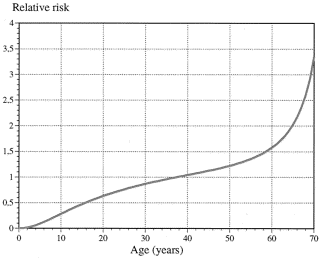
The number of patients suffering from a hemorrhage within the first 2 years after GKRS was
found to be 56, equaling an average annual incidence of
posttreatment hemorrhage of 1.8%. Of those, 25 (45%) occurred within the first 6
months after the treatment. Both Dmin (p = 0.0002), and Dave(p = 0.0003) were related to
the incidence of posttreatment hemorrhage, while Dmax was not (p = 0.94). For both Dmin and Dave, the higher the dose, the lower the incidence of
posttreatment hemorrhage. |